
REVIEW · HISTORICAL TOURS
Private History tour – small group
Split can feel confusing at first. What makes this private history tour work is the tight route plus a guide who can explain what you are actually seeing. You start in a central spot and walk through the core sights of Diocletian’s Palace and the surrounding old-town squares in about 2 hours.
I especially like the way Ivan Fistanić keeps the story grounded in stone, from the Golden Gate to the Peristyle and the Roman-era details that still shape Split today. I also appreciate the small-group setup, up to 10 people, so questions do not get swallowed by a crowd. One consideration: it is a walking tour focused on outdoor viewing, so if you want long inside time in major sites, this may feel more like an education walk than a ticket-heavy day.
Key highlights you will feel in your feet and your head
- Master’s Degree in History guide: Ivan Fistanić ties facts to visible details, from imperial space to later Christian change.
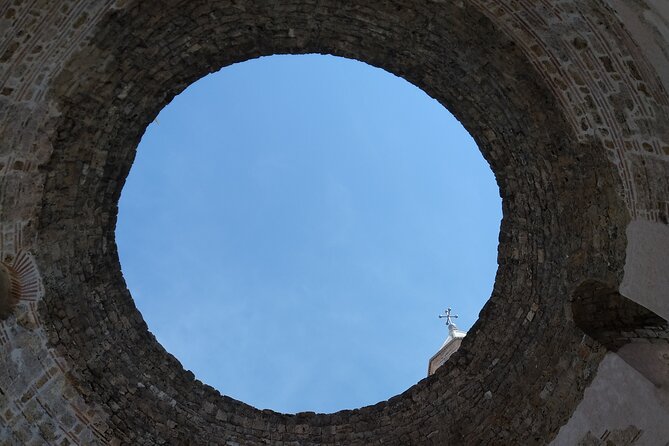
- Diocletian’s Palace route that makes sense fast: Golden Gate, Peristyle, Vestibulum, and the Triclinium area are connected in one sweep.
- Best-preserved Roman sights, explained without rushing: Cathedral of St. Domnius is covered, and you do not need to enter.
- Late Roman Temple of Jupiter, with a Middle Ages twist: you learn how it was converted into a baptistery tied to St. John the Baptist.
- Split street-life stops that keep it real: Riva Harbor, Fruit’s Square, and Pjaca give context beyond the palace walls.
- A fun local ritual at the Grgur Ninski statue: rub the toe for good luck.
A short private walk that gives Split its order
This tour is built for the moment you arrive in Split and realize the old town is not random. You get a structured route that links one monumental space to the next, instead of bouncing between landmarks with no thread. It is the kind of walk that helps you understand why locals still pace the same paths centuries later.
The format is also friendly for real-life travel. You meet at a central address, you get a mobile ticket, and the tour runs about 1 hour 30 minutes to 2 hours. And since it is private for your group, the pace stays human, not bus-assembly-line slow.
You can also read our reviews of more private tours in Split

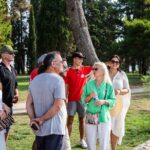
Meet Ivan Fistanić, and why his history background matters
Your guide for this tour is Ivan Fistanić, and he has a Master’s Degree in History. That does not mean long lectures. In practice, it means he can explain what you are looking at, then answer the natural follow-up questions that pop up when you see Roman architecture sitting inside a living city.
That focus comes through in the way the stops are chosen. You are not just pointed at famous names. Each stop feeds the next one, so you start recognizing patterns, like where imperial authority was staged, and how later eras repurposed existing spaces.
It also helps that the route stays short enough to keep attention. When the tour is under a couple of hours, you do not have to fight fatigue to absorb the story.
Entering Diocletian’s Palace: Golden Gate and the Peristyle
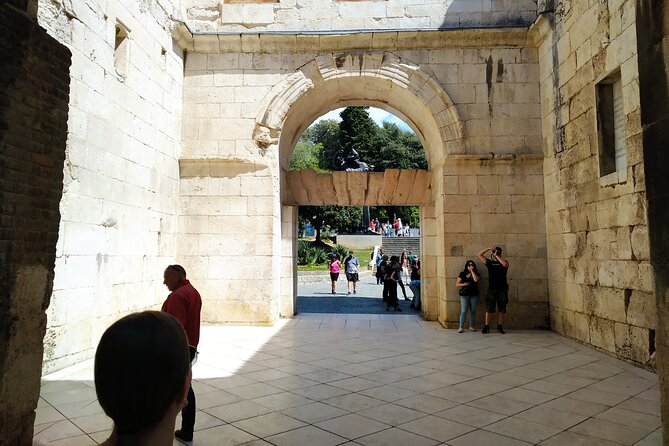
The experience kicks off at the Golden Gate, the main entrance to Diocletian’s Palace. It is one of the four Roman gates into the palace complex, and it sits on the road heading north toward Salona, the Roman provincial capital and Diocletian’s birthplace.
Even if you have read a bit about the palace already, this stop is useful because it gives you geography. You learn how a gate is not just decorative. It connects the emperor’s world to the wider Roman system, with Salona as a key reference point.
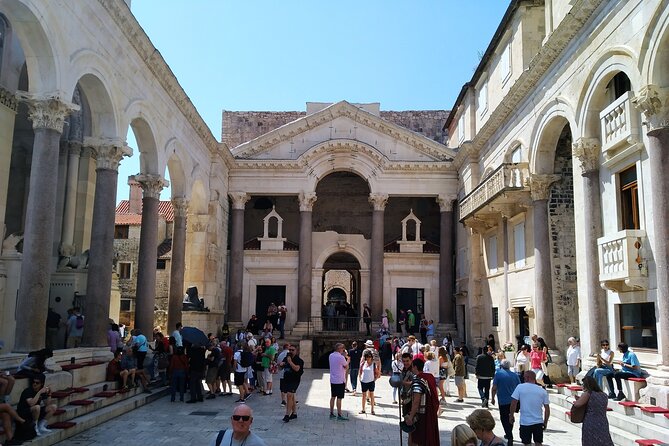
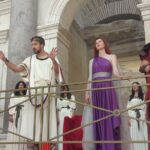
From there you move into the heart of the palace story at the Peristyle. You enter the central part of the cellars first, where Ivan explains the palace’s usage over time. Then you come out into the imperial square, framed by monumental arcades and oriented toward the imperial loggia.
What I like about the Peristyle stop is that it trains your eye. You can actually see how the design supports ceremony and power, not just “old stones.” You also hear about transitions caused by the expansion of Christianity, which helps you understand why the Roman layout later changed its role in the city.
Cathedral of St. Domnius, covered well without going inside
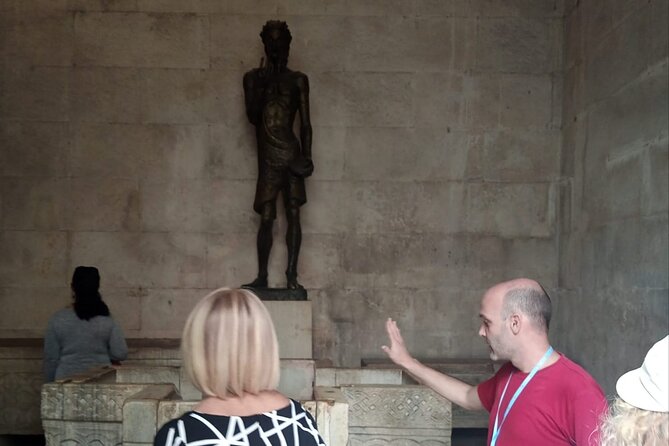
Next up is the Cathedral of Saint Domnius. From the Peristyle, it is hard to miss, and Ivan points out significant parts of the cathedral while explaining the story behind it.
Here is the practical bit: you do not enter the cathedral. Admission for entry is marked as not included, but since the tour is designed around what you can see outside, you still get the key context. The cathedral is described as one of the best preserved Roman structures in Split and it is still in use today, so you get the sense that these walls are not just museum props.
If your day plan includes lunch or more wandering after the tour, skipping entry can actually be a plus. You keep your momentum without losing time to lines or inside-only pacing.
The Temple of Jupiter: from emperor link to baptistery
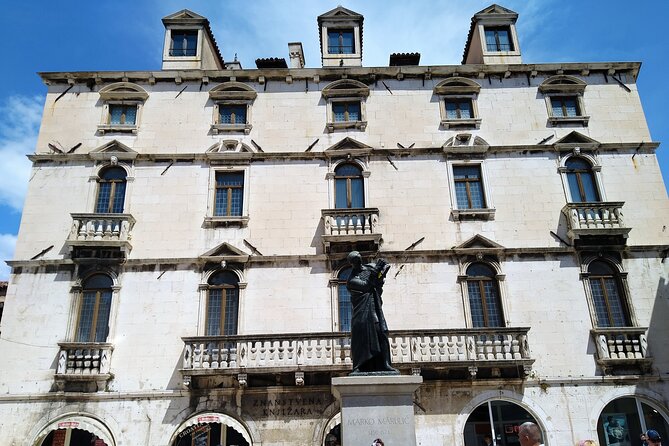
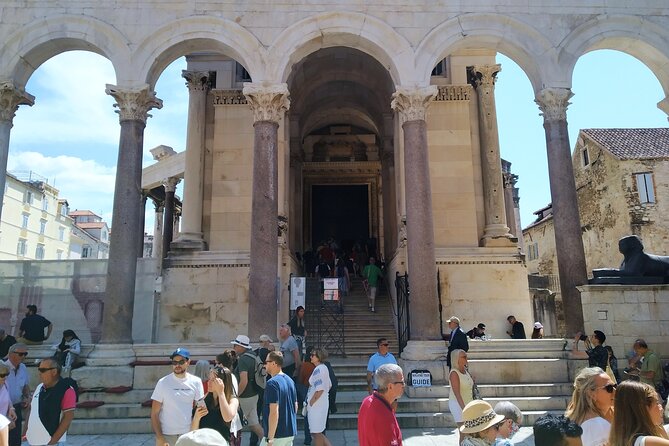
The Temple of Jupiter is one of the best preserved late Roman temples in the world. The stop is short, but it has big storytelling power because you learn why it was located where it was.
Ivan explains that the placement was meant to show a divine link between Diocletian and Jupiter, the Roman god of the sky and thunder, and king of the gods. Then you get the later twist: during the Middle Ages, the temple was converted into a baptistery dedicated to St. John the Baptist.
This is the kind of moment that makes Split feel layered. You are standing in one structure that carried different meanings across eras, without needing to guess. It is all tied to what you can observe on site.
You can also read our reviews of more historical tours in Split
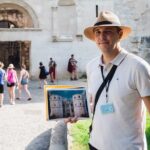
Vestibulum and Triclinium: Diocletian’s private rhythm
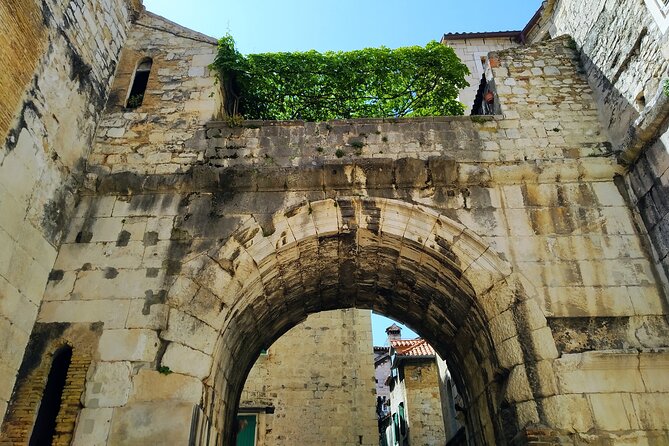
The Vestibulum of Diocletian’s Palace is next. This is the pre-entrance to Diocletian’s private chambers, and the tour treats it like more than a hallway. You learn what it looked like and what its function was, and then you also “check up” the Triclinium, the dining space associated with formal meals and social status.
This stop works well because it adds a human angle. After seeing imperial public spaces like gates and squares, you start learning how the palace also operated privately. You get a sense of how power worked in both directions: staged for the world, but also controlled in intimate rooms.
Riva Harbor: the city promenade that frames everything else
After the palace core, you step back into the street-level pulse of Split at Riva Harbor. This is the main city promenade and also a meeting point for locals and visitors. Ivan explains how Riva was built over centuries and why it matters for everyday life.
The viewpoint from here is another key reason this stop is worth it. From Riva, you get a beautiful view of the southern wall of Diocletian’s Palace. It is an easy mental reset, because you stop thinking only about ruins and start thinking about how the palace edge still shapes the city’s boundaries and views.
If you like photo stops that also have meaning, this is one. You are not just taking a shot, you are orienting yourself.
Fruit’s Square and Pjaca: old walls, old civic roles
The tour continues toward Fruit’s Square (Trg Brace Radic), one of the most picturesque squares just outside the palace. Here you hear about a significant monument in the middle of the square and about nearby important sights.
The square is dominated by remains of a 15th century Venetian fort. That detail matters because it shows how Split did not freeze after Rome. Different rulers repurposed spaces, and you can still spot the physical fingerprints of later periods.
Then you walk to Pjaca, Split’s main square since medieval times. It sits in front of the old town hall outside the western wall of Diocletian’s Palace. You learn what has always pulled people here: it is a public space built for movement, trade, and social life.
On Pjaca, you can see structures including a 14th century town hall. The value of the guided stop is that it stops you from treating the square like a scenic pause. Ivan helps you read the space as civic history, not just a backdrop.
Grgur Ninski statue: the landmark with a story and a ritual
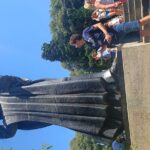
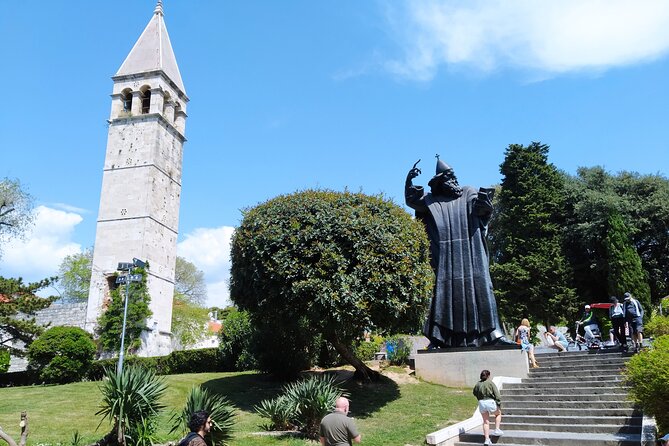
You finish with the Grgur Ninski Statue, one of Split’s most recognizable landmarks. Ivan shares interesting facts about Gregory of Nin, including the highest monument in Split dedicated to him, and the work of sculptor Ivan Mestrovic.
There is also a fun tradition baked into the stop. The tour includes the tip to rub the statue’s toe for good luck. It is simple, but it makes the last moment memorable, and it is the kind of local touch that helps you feel like you are part of the place, not just passing through.
What makes the pacing feel right (and what to expect)
This is not a long, exhausting hike. The time split is built around short, focused stops, with the heaviest chunk spent in the Diocletian’s Palace core. Even with explanation, most stops are around 10 to 15 minutes, except for the squares where you get more room to absorb the civic setting.
A practical tip: wear comfortable shoes. You are on foot through uneven old-town surfaces, and the route covers multiple monumental areas without long breaks.
Also plan your expectations around access. The Cathedral of Saint Domnius is covered but not entered. The Temple of Jupiter is explained without you needing admission for the stop. That keeps the tour smooth, but it also means you should not come expecting a lot of indoor time.
Price and value: $238.28 per group for up to 10
The listed price is $238.28 per group, with a group size of up to 10. That matters more than it sounds, because a private guide can be a much better deal than it appears once you split the cost.
You are paying for three things: a local historian guide (Ivan Fistanić, with a Master’s in History), a route that connects key palace and old-town sights, and a pace that fits a small group. When you think about the alternative, it is easy to waste time wandering on your own and missing how the stops connect, especially inside and around Diocletian’s Palace.
So I see this as good value if you want orientation and clear explanations rather than a checklist. If you already know Split deeply and just want a self-guided photo walk, you might not get as much from the guiding portion. But if this is your first serious day in town, the payoff is real.
Weather, walking style, and when this tour fits your day
This experience requires good weather. If it is canceled due to poor weather, you are offered a different date or a full refund. Since much of the route is outdoors, that rule makes sense, and it also helps you plan wisely on a trip day with a weather buffer.
The tour is designed for most travelers to participate. You are moving at a manageable pace through central old-town areas and major landmarks. Still, if you have limited mobility, walking-focused tours can be tough, even when the duration is short. It is worth thinking about your comfort level with uneven surfaces before you book.
Who should book this private history tour
This tour is a great fit if you want:
- A first-time orientation to Split that actually explains what you see.
- A guide who can connect Roman architecture to later Christian and civic changes.
- A small-group private experience rather than a crowded walking tour.
It is also ideal if you like history with visible evidence. When Ivan talks about the Golden Gate’s Roman links, the Peristyle’s imperial square design, and the temple’s conversion into a baptistery, you are not being asked to imagine. You are standing in the spaces where the story happened.
If you have already planned a lot of museum time and want a low-stress, story-rich walk instead, this fits nicely.
Should you book it?
I think you should book it if your goal for Split is understanding. The route is built around the palace core, then expands into the promenades and squares that show how the city continued after Rome. With Ivan Fistanić, you get clear explanations and the kind of history you can point to, not just read later.
Skip it only if you prefer long indoor visits and self-paced exploration over guided context. Otherwise, this is one of those tours that helps you enjoy the rest of your day more, because Split starts making sense faster.
FAQ
How long is the Private History tour in Split?
It lasts about 1 hour 30 minutes to 2 hours.
How many people are in each group?
It is a private tour for your group only, with up to 10 people.
Where does the tour start and end?
The meeting point is Ul. kralja Tomislava 15, 21000, Split, Croatia, and the tour ends back at the meeting point.
What does the ticket include?
You receive a mobile ticket. Some sites are free to view on the route, while admission for the Cathedral of Saint Domnius and the Temple of Jupiter is not included.
Do you enter the Cathedral of Saint Domnius?
No. The tour does not enter inside the cathedral, but it covers significant parts and explains the story.
What happens if the weather is bad?
This experience requires good weather. If it is canceled due to poor weather, you are offered a different date or a full refund.
More Private Tours in Split

More Tours in Split

More Tour Reviews in Split

Not for you? Here's more nearby things to do in Split we have reviewed




More Historical Tours to consider.
 ★ 5.0Walking Tour of Split with a ‘Magister’ of HistoryFrom $341,122 reviews
 ★ 5.0Split Walking Tour with Professor of HistoryFrom $24926 reviews
 ★ 4.9History and Heritage Walking TourFrom $18650 reviews
 ★ 5.0Split History and Gastro Small-Group Tour with Food and DrinksFrom $139375 reviews
 ★ 5.0SPLIT-PREMIUM Emperor’s Walking Tour for History Lovers + MuseumFrom $30333 reviews
 ★ 5.0Local History and Culture 90-Minute Walking TourFrom $17194 reviews
 ★ 5.0Private History Split Walking Tour in EnglishFrom $66159 reviews
 ★ 4.9Historical & Gastro Treasures Tour with Green MarketFrom $135144 reviews
Explore its other useful categories