
REVIEW · SPLIT CITY & DAY TOURS
Private History Split Walking Tour in English
Split’s layers get confusing fast, unless someone lines them up. This private History Split Walking Tour in English threads the story of Diocletian’s Palace through the Old Town, from the Peristyle square to the Golden Gate area, then out toward Riva and Fruit’s Square. I especially like how the pace stays human, with a guide who can explain what you are actually looking at, not just read dates off a wall.
Two more things I like: you get a true private tour feel with only your group, and the stops are built around landmarks you’ll want to find again later on your own. One possible drawback to plan for, though, is that it’s not recommended if you have issues with high steps, since parts of the palace complex can mean stairs and uneven ancient surfaces.
Key moments that make this tour worth your time
- Peristyle of Diocletian’s Palace as the fast orientation point for the whole complex
- Vestibulum stop, which adds personality to the Diocletian story
- Diocletian’s Palace substructures walk-through without the museum portion
- Golden Gate and Gregory of Nin, including why he matters for Croatian language
- Riva Harbor and a bronze palace model, great for visualizing the palace in context
Diocletian’s Palace, the real “map” of Split
If you only have a short time in Split, Diocletian’s Palace is the best place to start. Everything feels tied to it, even when you are walking a few streets away. On this tour, you begin with the palace spaces that act like the system’s main corridors and decision points.
I like that the tour keeps you focused on what changes your understanding of Split. You do not just see big sights. You also get the logic of how the palace was laid out, and why locals still talk about it in everyday language.
And because it is a private tour, the guide can slow down if you want more architectural detail, or speed up if you’d rather get photos and keep moving.
You can also read our reviews of more walking tours in Split


Peristyle ulica and the Vestibulum, where the palace story starts
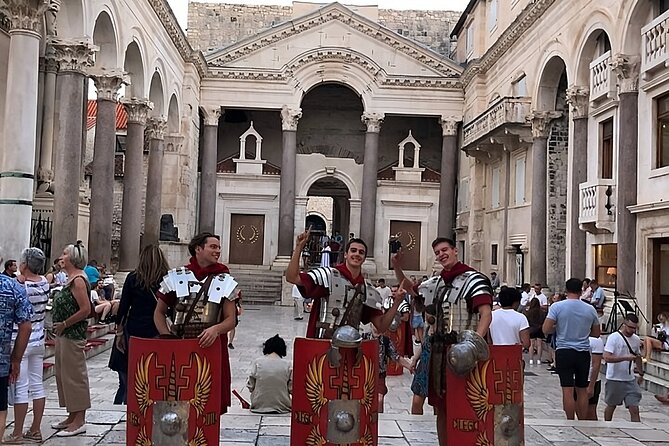
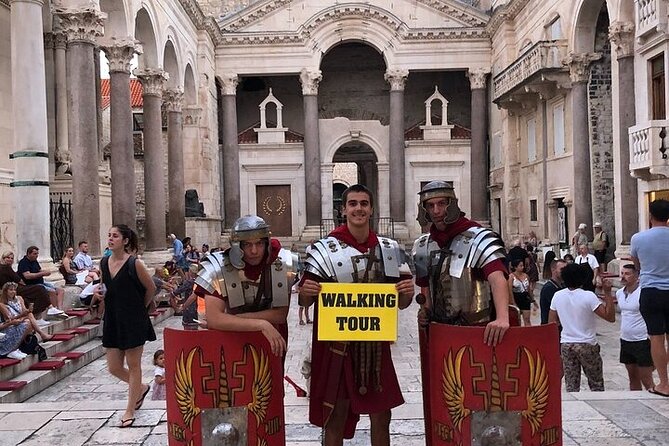
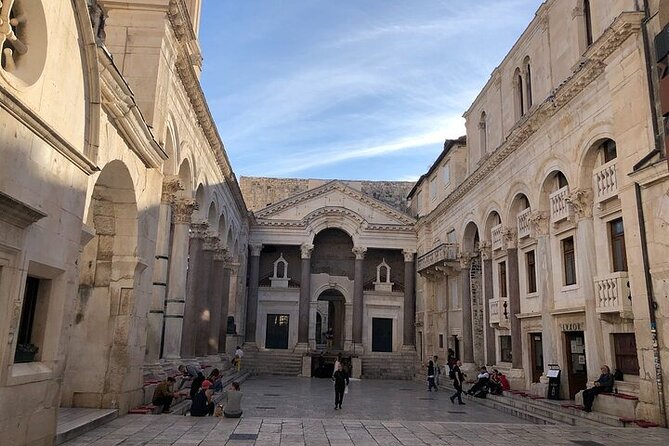
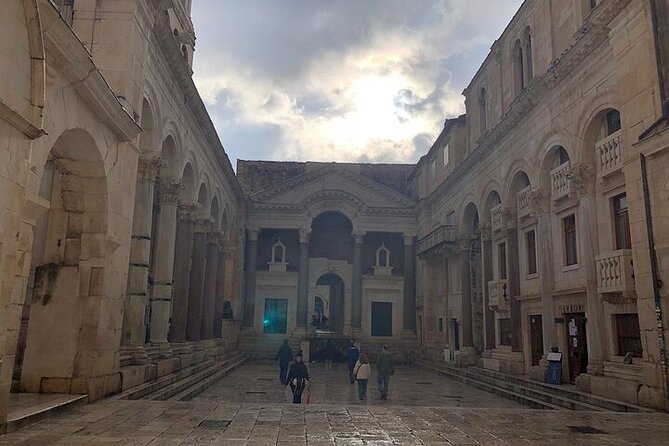
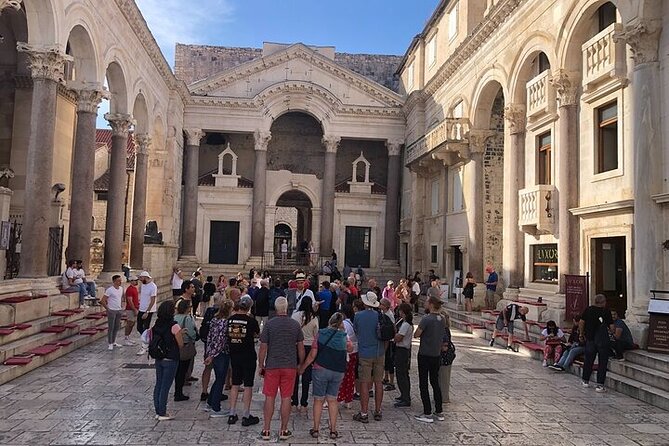
The tour kicks off at the Peristyle of Diocletian’s Palace, the central square that connects you to almost everywhere else inside the palace. This is a smart opening stop because it gives you a mental map quickly. Once you understand the center, later corners make more sense, and you waste less time second-guessing directions.
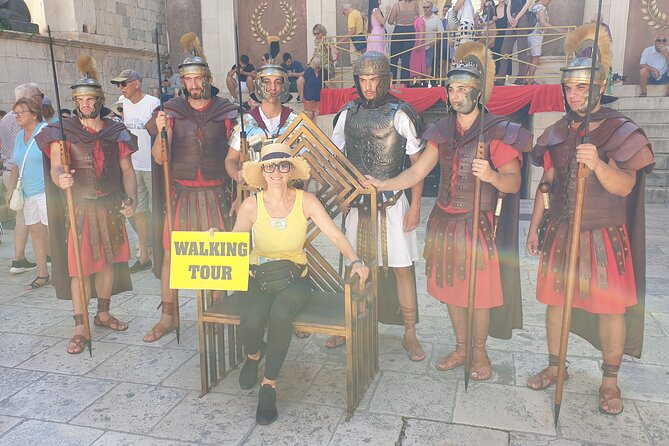
From there, you move into the Vestibulum. It is a smaller, more intimate space than the main square, but it helps you understand the emperor’s presence in the building layout. If you’re into storytelling with atmosphere, this is one of those stops where you might catch local traditions being mentioned, including the possibility of traditional Dalmatian singing.
What makes this pair of stops valuable is that they do the heavy lifting early. You leave the first 20 minutes with a clearer sense of where you are and what you are looking at.
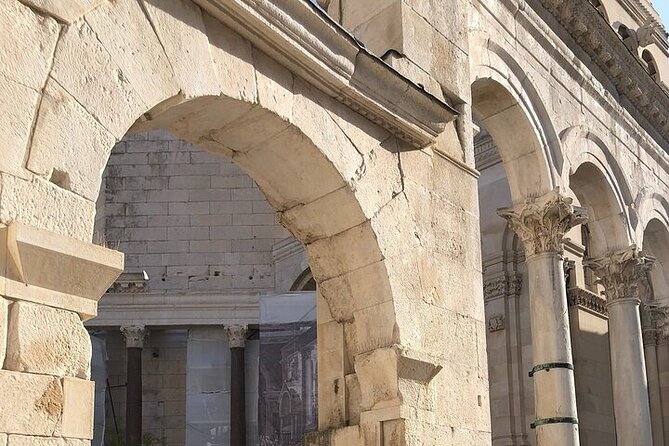
Practical note: these are palace interior areas, so expect stone textures, narrow passages, and plenty of “look up” moments.
Substructures under the palace, plus what you do not do
Next is the walk through the Diocletian Palace substructures. This part matters because it connects the visible palace above with the spaces that supported daily life and later uses. The tour explains the history of construction and how the function shifted over time.
Here’s the trade-off: the tour does not include the museum portion of the substructures. The admission for the substructures area is listed as not included, and you can visit the museum part after the tour if you want to go deeper on your own.
That is a good choice for many people. If you are short on time, you still get the big picture without getting stuck reading placards for an hour. If you love museums and want the full indoor experience, you can add that later.
Also, keep in mind that this is walking through an underground or semi-underground environment. Even when the surfaces are manageable, the stone can be slick or uneven, depending on weather.
Golden Gate and Gregory of Nin, history with a language twist
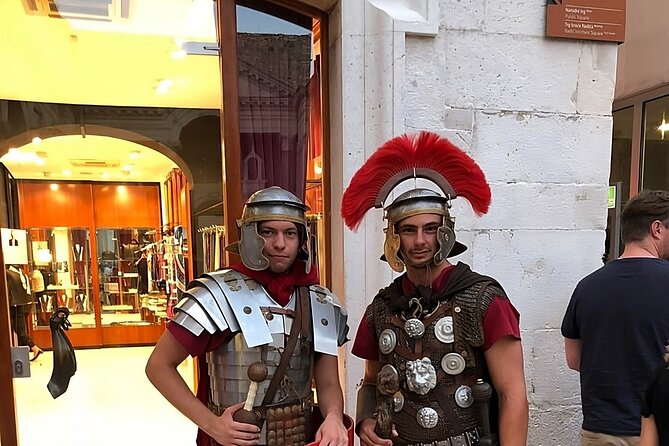
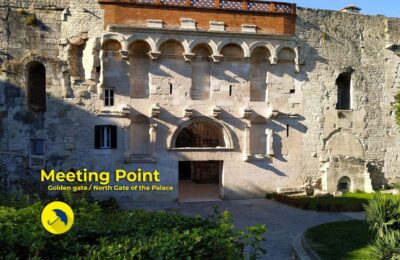
The Golden Gate stop is one of the best-photo moments on the route. It is the main entrance feel for Diocletian’s Palace, so it naturally sets you up for the “before and after” contrast between the ancient power structure and the modern city built around it.
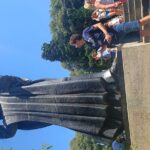
This is also where the tour highlights Gregory of Nin. You see his statue, and you learn why he matters not only in history but also for Croatian language. That language angle is what makes this stop more than a pretty monument. It links identity and culture back to the city’s deeper timeline.
If you like when guides connect architecture to people, this is the moment. You can almost feel how the city explains itself through symbols: an emperor’s walls, a saint-figure, and a door that became a civic reference point.
Stay alert here for photo framing. The gate has lines that look best when you include surrounding stone and passageways, not just the statue alone.
Riva Harbor and the bronze palace model, building the mental picture
After the palace core, you shift toward the waterfront area with Riva Harbor. This stop includes a bronze model of Diocletian’s Palace, which is genuinely useful. Even if you think you understand the palace layout from the earlier stops, the model can correct your mental map in seconds.
Then the guide ties it to Split’s Riva promenade, explaining the history behind why this area became the city’s front stage. It’s the kind of stop that helps you stop treating Split as only a collection of monuments. Instead, you see how the palace shaped the city edge and how the waterfront became a social center.
One practical reason I like this stop: it gives your legs a small change of scenery. You’re still walking, but now you’re moving toward open views and the kind of streets where you can pause for a coffee or just people-watch after the tour.
You can also read our reviews of more private tours in Split



Fruit’s Square (Trg Brace Radic) and Marko Marulić
Next comes Fruit’s Square, known as Trg Brace Radic. This stop is a reminder that Split did not pause after the Romans. The tour connects the square to a 15th-century Venetian citadel and explains what that meant for the city’s evolution.
It also spotlights Marko Marulić, described as the father of Croatian literature. You learn why his name belongs here, and you get the sense that Split’s identity did not only grow through rulers and armies, but through ideas and writing too.
This is a stop that works especially well if you like cultural stories. If you only care about ancient stone, you might find it a little more abstract. But even then, it helps you understand why Croatian culture is “visible” in the city, not just something you read about later.
Photo tip: the square can look different depending on the light and time of day. If you’re taking pictures, plan for one quick wide shot to capture the layout, then move closer for details.
Split Synagogue, seen from the street
You end this history-focused loop by passing by the 16th-century Split Synagogue. Importantly, the information says you pass by rather than enter, and the admission ticket is not included.
This makes the stop a good “respectful overview” moment without dragging your schedule. You still get context on the Jewish people’s presence in Split, which broadens the story beyond the Christian and Roman narratives you’ll hear more often in this city.
If you want to see inside, you’ll need to plan separately based on that museum or site’s own hours and ticketing, since the tour does not include entry here.
How much you pay, and what you actually get for the money
The price is listed at $66.54 per person, for about 1 hour 30 minutes, and it is a private experience for only your group. On paper, that might sound like a “premium” option, but the value becomes clearer when you look at how the tour is structured.
You are paying for two things: guided interpretation and time efficiency. This is not a random Old Town walk. The stops are arranged around Diocletian’s Palace logic, then around the city points that connect the palace to later cultural life. A good private guide cuts your confusion, and confusion costs time in Split.
You also have a couple of built-in advantages:
- Some stops have free admission, so you are not paying repeatedly throughout the walk.
- You get a mobile ticket, which usually simplifies entry points.
- Group discounts are mentioned, which can help if you are traveling with friends or family.
One more value point: the reviews scoring is extremely strong, and the comments repeatedly mention how the guide brings the palace alive with clear explanations. One named guide, Antonella, is specifically praised for turning the history into something you can actually picture. That kind of delivery matters in a place like Split, where the stones can look similar unless someone helps you separate what is important from what is background.
The walking reality: who will love this, and who should reconsider
Most people can participate, and it is described as near public transportation. That matters because you can start with confidence, even if you are not planning your day like a military operation.
That said, the tour is not recommended for travelers who have issues with high steps. If stairs and uneven stone are difficult for you, this might feel slower or more stressful than you want. Ask in advance how much stair climbing is involved for your specific dates, since the palace terrain can vary by route and crowd levels.
If you do fine on foot but want to avoid museum time, this tour is a nice compromise. You get the main spaces and key cultural nodes without committing to long indoor stops.
If you are traveling as a couple, this is also an easy win. You get the intimacy of private guiding without needing to coordinate with a larger group.
Practical tips so your tour day runs smoothly
A few small choices can make a big difference on this kind of Old Town walk.
First, wear shoes you trust on stone. Ancient surfaces look charming in photos, but you want traction more than style. Second, keep your camera handy early. The palace center and Golden Gate are both photo magnets.
Finally, use the tour to gather names and mental anchors. If you remember where the Peristyle square sits, what the Golden Gate represents, and why Gregory of Nin matters beyond the statue, you’ll feel oriented for the rest of your time in Split.
If the guide offers suggestions for what to do next, take notes. Even without extra planning, that kind of locally guided direction often beats wandering without a plan.
Should you book this Private History Split Walking Tour?
Book it if you want a guided, history-led walk that helps you understand Diocletian’s Palace quickly, then connects it to Split’s later cultural story. I’d especially recommend it if you like architecture plus clear explanations, and you want to get your bearings without spending your whole day inside museums.
Consider skipping or choosing a different format if you cannot handle high steps or you know you want to include museum entry at the substructures or inside the synagogue. This tour keeps its scope tight on purpose, and a museum lover might prefer a version with included admissions and longer indoor time.
Bottom line: for a short stay, this is a strong way to turn the palace from a maze into a story you can follow. And once you see the Golden Gate, Gregory of Nin, the Riva context, and Marko Marulić’s place in the city’s identity, Split feels a lot less random.
FAQ
How long is the Private History Split Walking Tour?
It lasts about 1 hour 30 minutes.
Is this tour private?
Yes. It is a private tour, so only your group participates.
What language is the tour offered in?
The tour is offered in English.
Is a mobile ticket included?
Yes. The tour includes a mobile ticket.
Do I need to buy admission tickets during the tour?
Some stops are free, while others are not included. The tour notes that the Diocletian Palace substructures stop has an admission ticket not included, and the Split Synagogue admission is not included since you pass by rather than visit.
Where does the tour start?
The meeting point is at Peristil ul., 21000, Split, Croatia.
Is the tour suitable for people with mobility issues or stairs?
It is not recommended for travelers who have issues with high steps.
What is the cancellation policy?
Free cancellation is available up to 24 hours in advance for a full refund. If you cancel less than 24 hours before the experience starts, the amount paid is not refunded.
More Walking Tours in Split


More Tours in Split

More Tour Reviews in Split


Not for you? Here's more nearby things to do in Split we have reviewed






More Split City & Day Tours to consider.
 ★ 4.8Krka Waterfalls Trip with Boat Cruise and SwimmingFrom $3110,519 reviews
 ★ 5.0Krka Waterfalls, Food & Wine Tasting TourFrom $459,326 reviews
★ 4.9Krka Waterfalls, Food & Wine Tasting TourFrom $446,598 reviews
★ 5.0Krka Waterfalls, Food & Wine Tasting TourFrom $459,326 reviews
★ 4.9Krka Waterfalls, Food & Wine Tasting TourFrom $446,598 reviews
 ★ 4.6Split/Trogir: Blue Cave, Mamma Mia, Hvar and 5 Island TourFrom $1096,320 reviews
 ★ 4.5Blue Lagoon & 3 Islands Cruise with Lunch from SplitFrom $785,756 reviews
 ★ 4.9Old Town and Diocletian Palace Walking TourFrom $174,727 reviews
 ★ 4.9Blue Lagoon Boat Party with DJs, Shots & After PartyFrom $474,610 reviews
 ★ 5.0Krka Waterfalls Tour, Boat Cruise & SwimmingFrom $324,489 reviews
Explore its other useful categories