
REVIEW · SPLIT CITY & DAY TOURS
Split Walking Tour with Professor of History
Split has layers, this tour shows them fast. It’s a guided walk through the core sights of historic Split, including Diocletian’s Palace lanes, squares, and gates. You’ll get the why behind what you see, not just a list of stones.
I love the history-professor style of the storytelling, with guides like Mario and Anita turning Roman and medieval Split into a clear, talk-about-it kind of experience. You’ll also like the small group size of up to 17 people, which keeps questions in play and crowd-chasing to a minimum.
One consideration: the pace can run long. The tour is listed at about 2 hours 20 minutes, but it may stretch to around 3 hours depending on timing and how much the guide unpacks at each stop.
Key highlights to watch for
- A professor-led walk through Diocletian’s Palace with clear context at every turn
- Most stops have free admission, so your money goes to the experience, not ticket math
- Outside-only views at Saint Domnius and the Temple of Jupiter, with guidance if you want to enter later
- Small-group feel (max 17), which helps you actually hear the details
- Local-life stops like Riva Harbor and Fruit Square that feel less like museum time
- Story-driven street moments, including Let Me Pass Street and the Golden Gate’s comeback
Why a History Professor Changes How You See Split
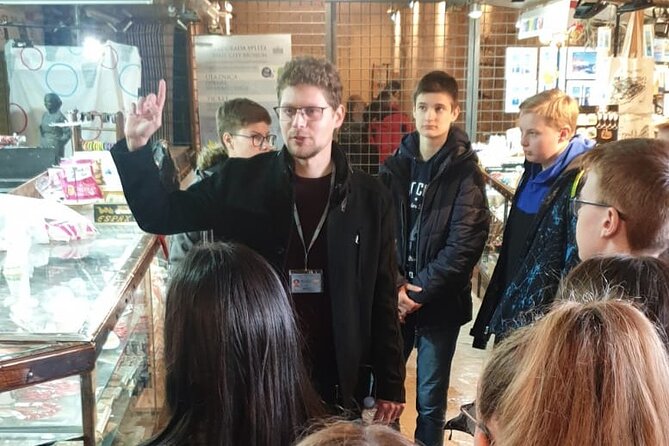
Split can feel like one of those places where everyone points and says “ancient, ancient.” This tour does the opposite. A professor-led approach helps you connect the dots between Roman power, later religious reuse, and the city that grew around the palace.
I also like that it’s not just theater. The walk stays practical: you get directions where you are going next, what to notice right there, and what to save for later if you want to see interiors. That is a big deal in Split, because you can easily lose time wandering without a plan.
Finally, the guide style tends to be lively. In past walks, you may hear more humor and trivia than you’d expect, plus myth-busting about things you might read elsewhere. That keeps the brain awake on a stone-heavy route.
You can also read our reviews of more walking tours in Split

Starting at Porta Aenea, Where the Old Town Breathes
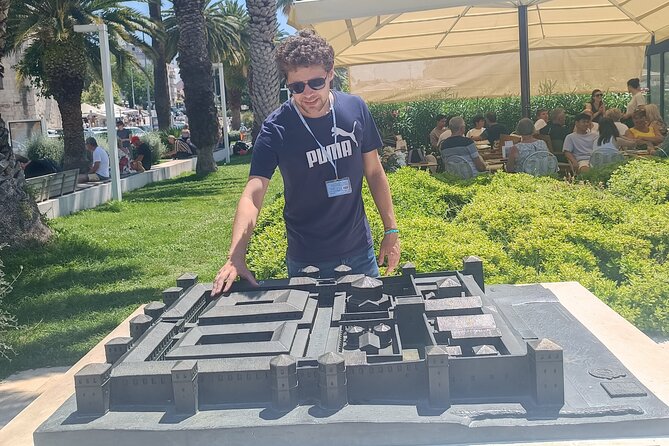
You begin at Brass Gate (Porta Aenea), right on the waterfront side of old Split. The location matters because it frames the city the right way. This isn’t a start-in-a-square-and-pretend-the-water-doesn’t-exist situation. You’re close to where locals actually spend time.
From there, you move to Riva Harbor along the Riva promenade, near the famous model of the Palace. This is the spot where coffee, sunshine, and everyday public life blend together. It’s a good warm-up before you step back in time, because the setting helps you understand that the palace isn’t some isolated ruin. It’s part of a living city.
Practical tip: Plan for a little sun on this approach. Even if the tour pace includes pauses, you’ll still spend time outdoors early on.
Riva Promenade to Diocletian’s Substructures: The UNESCO Reason
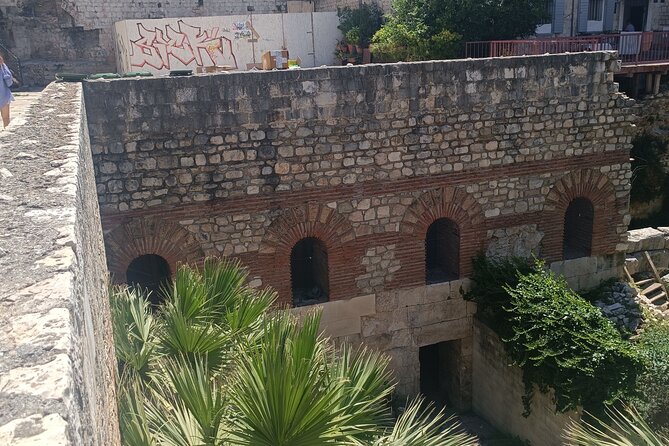
One of the strongest stops is the Diocletian Palace substructures, the basement halls that are among the best-preserved complexes from classical antiquity. This is where you start to understand why Split’s historic center earned UNESCO status in 1979.
You’ll see a huge, structured space, not a small “here’s a wall” moment. And the guide’s job is to translate what you’re looking at into why it mattered. The substructures help explain how the palace functioned, and how later generations built upward into a city that already had bones.
Drawback: you may feel like you are in a cool, echoing shell of stone (in a good way). If you’re sensitive to enclosed spaces or sound, you might want to keep your attention on the guide’s explanations, so you don’t just get swept up in visuals.
The Peristyle: Where Power Looked Down
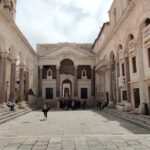
Next you reach the Peristyle, the central square of Diocletian’s Palace. The Peristyle is not just an open courtyard. It’s the stage set for how an emperor’s presence shaped daily movement and belief.
The guide points out how Diocletian was presented as living in divine terms, and how people approached him in carefully described ways, like kneeling and kissing the edge of his scarlet cloak. It’s the kind of detail that makes you stop and rethink what you’re seeing. This isn’t random decoration. It’s propaganda you can walk around.
If you’re a photo person, this is one of your best chances. If you’re not, you’ll still appreciate the “why” behind the layout, because it helps you read the palace like a map.
Vestibul and the Rotonda: A Grand Room for Selected Audiences
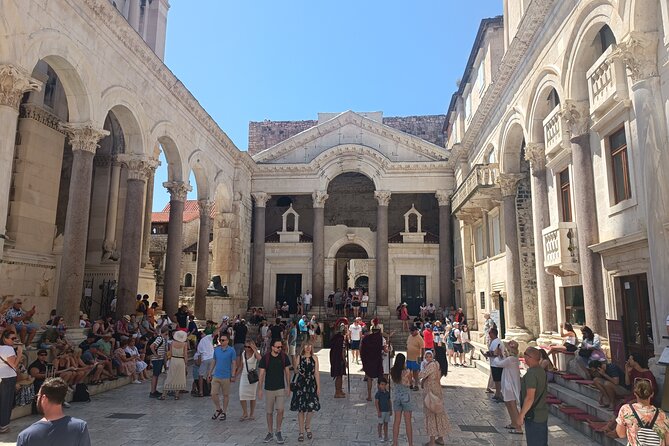
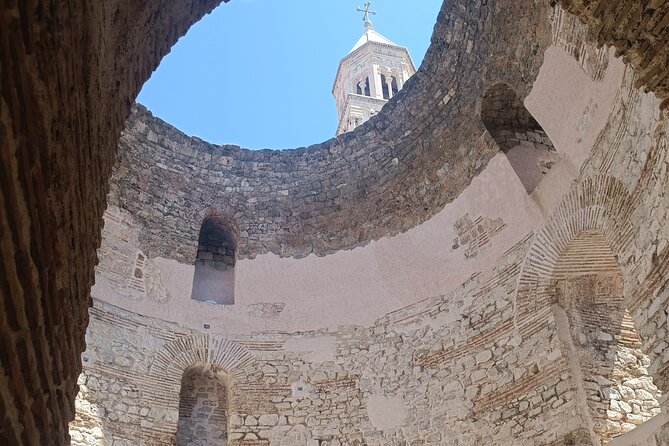
From the Peristyle, you move to the Vestibul, also called the Rotonda. This is the first section of the imperial corridor leading from the Peristyle into the imperial apartments.
The guide describes it as a circular hall built by the beginning of the 4th century, about 17 meters tall and 12 meters in diameter, and originally topped with a dome. The key idea is scale plus selection. This wasn’t a public hallway. It was a formal meeting space for selected audiences, including ambassadors.
The practical upside: this stop gives you a mental reset after more open areas. You can listen closely and visually track the geometry, which makes the history feel structured instead of overwhelming.
You can also read our reviews of more historical tours in Split

Saint Domnius and the Temple of Jupiter: Outside Views, Clear Next Steps
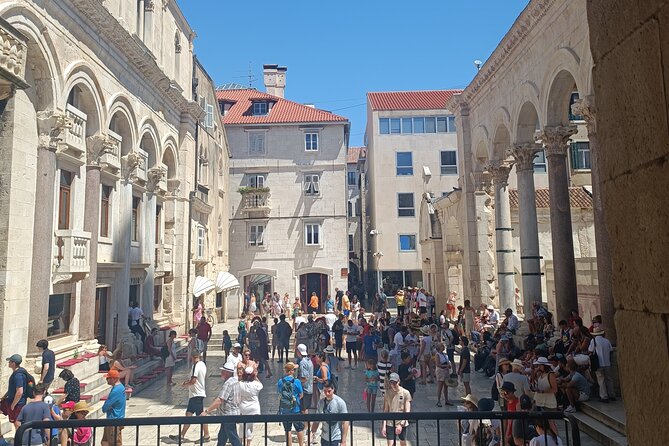
The tour includes Cathedral of Saint Domnius, with viewing from the outside only. Entrance is not included, so if you want to go in, you’ll need to pay separately after the walk. That’s still useful, because you get a guided orientation first. You’ll know what you’re looking for and what questions to ask once you’re inside later.
The guide also frames Saint Domnius as something you might see as Roman temple, mausoleum, and church depending on how you look at it. That layered identity is exactly what makes Split so fascinating. It’s not a single era preserved in amber. It’s centuries piled on top of centuries.
Then you move to the Temple of Jupiter, which was later converted into a baptistery dedicated to St. John the Baptist. Again, you view from outside only. The guide’s explanations help you notice how religious reuse changes the meaning of a space without erasing the original structure.
On the way toward the Golden Gate, you’ll pass through a tight street locals refer to as the narrowest street in the world, called Let Me Pass Street. Even if the exact claim makes you smirk, it’s still a fun, memorable micro-moment in the walk. It also gives you a quick sense of medieval street scale compared to Roman plans.
Golden Gate: The Main Door That Came Back
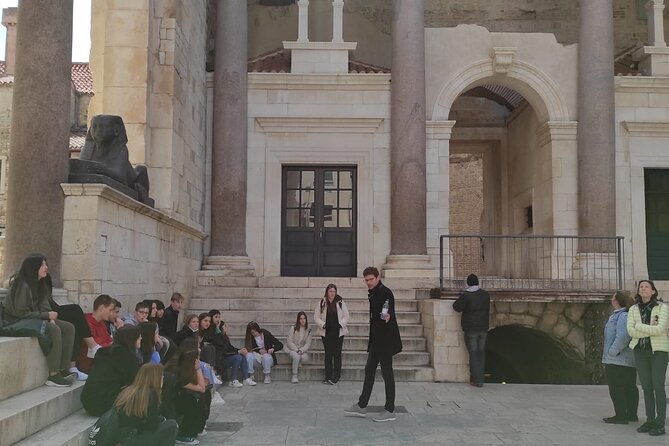
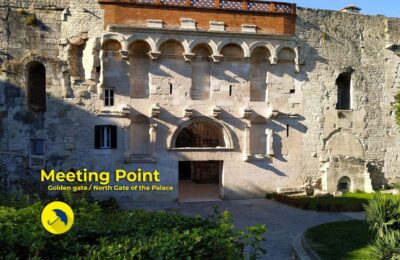
At the Golden Gate (the Northern Gate), you get a clear look at one of four principal Roman gates into the old town. It served as the main gate through which the emperor entered the palace and was decorated to reflect its status.
In the Middle Ages, the gate was sealed off, and it lost columns and statuary. Then in modern times, it was reopened and repaired. That “shut down, revived” storyline makes the architecture feel alive, like a building with a long memory.
If you want your visit to feel chronological, this is a great hinge point. You’ve seen palace function and later layering. Now you see how entrances and movement shaped power and identity over time.
Gregory of Nin, Marmontova Ulica, and Republic Square
After the gates and imperial spaces, the tour shifts into civic Split with stops that feel more human scale.
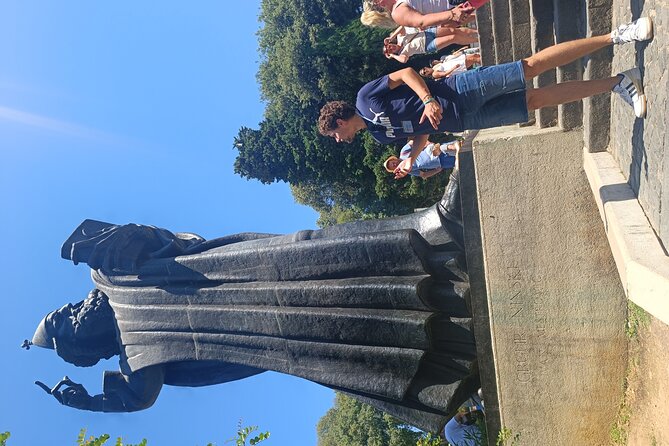
You’ll see the statue of Gregory of Nin by Ivan Meštrović, a towering figure that draws attention fast. The toe is polished from the tradition of rubbing it for good luck. It’s one of those things where the crowd behavior actually helps you understand the story, because you’ll see the toe with your own eyes.
Next is Marmontova Ulica, the street named after Napoleon’s marshal, Marmont. Even though he was a conqueror, he’s also linked to the urbanisation of Dalmatian cities. The street name is the civic answer to that history, a reminder that towns remember in their own way.
Then you reach Prokurative, the Republic Square area with neo-Renaissance buildings lining it on three sides. This is where Split shows a later layer of ambition, not just ancient stone. It’s a good transition stop before the walk ends.
Small-group bonus: In areas like these, you can pause, look up, and still hear explanations without fighting the crowd for attention.
Fruit Square and Marko Marulić: A Sweet Ending With Food Stories
The tour finishes at Fruit’s Square (Trg Brace Radic), a small and pretty square that once hosted fruit sellers. The setting feels calm compared to the palace zones, which makes the end of the walk feel like a breath rather than a scramble.
The guide connects the square to monuments nearby, including a statue of Marko Marulić, described as the father of Croatian literature. It’s a clever way to end because it nudges you beyond Roman ruins into national culture and identity.
This is also where gastronomy stories come in. Even if you do not eat during the tour, you’ll leave with ideas about where food fits into the city story. And that matters in Split, because meal planning is half the fun.
How Long It Takes, What to Wear, and What to Expect on Foot
The tour is listed at about 2 hours 20 minutes, but it can run longer. In practice, the time can stretch closer to 3 hours, especially if the guide takes questions at stops like the Peristyle or Golden Gate.
Plan your day like this: don’t schedule a tight ticketed event right after. Give yourself a buffer to get your bearings and, if you want, follow the guide’s suggestions for later entry at Saint Domnius or Jupiter’s Temple.
What to wear is simple. You’re walking in old-town stone streets. Comfortable shoes matter more than fashion. If it’s hot or sunny, bring water and use shade where you can. A good guide will keep the group moving and help you avoid standing still too long, but you are still outdoors.
Group size is small, up to 17 people. That is a big part of why the tour feels conversational instead of lecture-only.
Price and Value: What You Pay For, and What You Don’t
The price is $24.19 per person, and for me the value comes from three things.
First, you’re paying for expert interpretation, not just motion between sites. Split’s main sights can be impressive but confusing if you don’t know what you’re looking at. Here, the guide gives you context fast so you don’t waste time trying to figure it out mid-walk.
Second, most of the stops are free admission. You start at Riva Harbor, then visit key palace areas like the substructures, the Peristyle, the Vestibul, the Golden Gate, Gregory of Nin, and the city squares. The free access means you’re not constantly adding ticket costs.
Third, where entries are not included, the tour still helps you. Cathedral of Saint Domnius and the Temple of Jupiter are outside-only, and entrance is not included during the walk. That could feel like a downside if you want interiors right away, but it’s also a smart setup. You can choose later based on your interests and time.
One more value point: the tour uses a mobile ticket, and it runs in English. That reduces friction, especially if you’re juggling phones, maps, and changing weather.
Should You Book This Split History Walking Tour?
Book it if you want your Split visit to make sense quickly. This is ideal for first-time visitors who want a clean orientation to Diocletian’s Palace and the city that grew around it. It’s also a great choice if you like stories with structure, where Roman, medieval, and modern layers connect instead of feeling random.
Skip it or consider a shorter self-guided approach if you already know the Diocletian story and you’re in pure “I just want photos” mode. Also, if you strongly dislike longer walks, note that the tour can stretch beyond the stated time.
If you fall in the middle, like most of us do, this tour is a strong match. You get the big sights, the meaning behind them, and a small-group feel that keeps the experience personal. And you end in a real square, not a dead-end viewpoint, with ideas for what to do next in Split.
FAQ
Where does the tour start?
It starts at Brass Gate (Porta Aenea), Obala Hrvatskog narodnog preporoda 22, 21000, Split, Croatia.
How long is the walking tour?
The duration is approximately 2 hours 20 minutes.
Is the tour in English?
Yes, the tour is offered in English.
What group size should I expect?
The tour has a maximum of 17 travelers.
Is a mobile ticket used?
Yes, the tour offers a mobile ticket.
Are entrance fees included for all sites?
Most stops have free admission. Cathedral of Saint Domnius and the Temple of Jupiter are not included for entry, and the tour visits them from the outside only.
Are alcoholic beverages included?
No, alcoholic beverages are not included.
Are service animals allowed?
Yes, service animals are allowed.
What happens if the weather is poor?
The tour requires good weather. If it’s canceled due to poor weather, you’ll be offered a different date or a full refund.
Is free cancellation available?
Yes. Free cancellation is available up to 24 hours in advance for a full refund.
More Walking Tours in Split

More Tours in Split

More Tour Reviews in Split

Not for you? Here's more nearby things to do in Split we have reviewed






More Split City & Day Tours to consider.
 ★ 4.8Krka Waterfalls Trip with Boat Cruise and SwimmingFrom $3110,519 reviews
 ★ 5.0Krka Waterfalls, Food & Wine Tasting TourFrom $459,326 reviews
★ 4.9Krka Waterfalls, Food & Wine Tasting TourFrom $446,598 reviews
★ 5.0Krka Waterfalls, Food & Wine Tasting TourFrom $459,326 reviews
★ 4.9Krka Waterfalls, Food & Wine Tasting TourFrom $446,598 reviews
 ★ 4.6Split/Trogir: Blue Cave, Mamma Mia, Hvar and 5 Island TourFrom $1096,320 reviews
 ★ 4.5Blue Lagoon & 3 Islands Cruise with Lunch from SplitFrom $785,756 reviews
 ★ 4.9Old Town and Diocletian Palace Walking TourFrom $174,727 reviews
 ★ 4.9Blue Lagoon Boat Party with DJs, Shots & After PartyFrom $474,610 reviews
 ★ 5.0Krka Waterfalls Tour, Boat Cruise & SwimmingFrom $324,489 reviews
Explore its other useful categories