
REVIEW · SPLIT CITY & DAY TOURS
Split Palace & Old Town -Private walking tour- Entrance included
Split’s palace runs under your feet. This private walking tour threads you through Diocletian’s Palace and Old Town with key entrance fees included, so your sightseeing stays smooth instead of stop-and-start. I love how the guide makes Roman architecture feel practical, not museum-only, and I love that the walk ends in the heart of where locals linger at Procurative.
One heads-up: the experience depends on good weather, and if there are church services or special events, a couple sights may be adjusted. It is still the same overall route, just with small changes to keep things possible.
You also get a real private setup: only your group, in English, using a mobile ticket, and a total time of about 2 hours 30 minutes.
Key highlights at a glance
- Entrance tickets built into the walk: basement areas plus Saint Domnius Cathedral and the Temple of Jupiter
- Private guide, English speaking: you can ask questions while you move through the complex
- From Riva to Procurative: a full loop from seafront views into the Old Town squares
- Diocletian’s Cellars: well preserved, giving you a strong sense of the palace scale
- Fish Market plus sulfur baths: you get the funny science behind the lack of flies
- Napoleon-era Marmontova: a shopping street shaped by French rule in the 1800s
Split’s palace and old town, in one tight walk
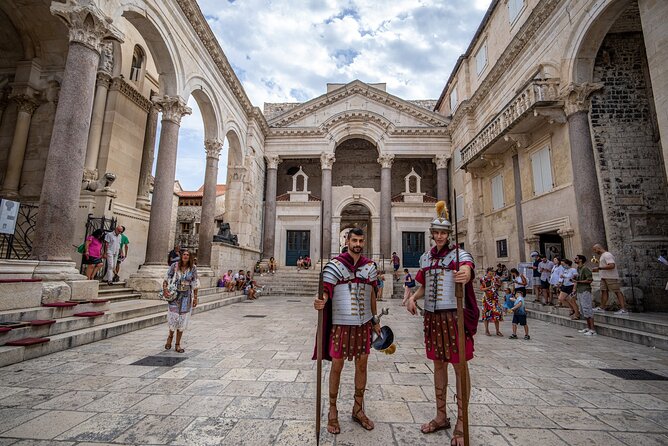
If you want one good reason to book a guided walk in Split, it is this: Diocletian’s Palace is not just a pile of old stones. It is a living maze of spaces that still shape how the Old Town works today. In about 2.5 hours, you get the story in the exact locations where the story happened.
You will start on the Riva, Split’s promenade. Then you move straight into the palace world, across major palace points, and out into Old Town squares and streets. The pacing feels designed for people who want context, but also want to keep walking and seeing.
You can also read our reviews of more walking tours in Split


Meeting at the historical core, then heading for the Riva
Your tour begins at the model of Split’s historical core, near Obala Hrvatskog narodnog preporoda 23. It is a handy spot because it helps you get your bearings fast before you start moving through the real streets.
From there, you head to Stop 1 at the Riva, the seafront promenade. This first stretch matters more than you might think. The guide uses it to set the stage for what you are about to see, including how Split developed around Diocletian’s palace.
If you like travel that starts with orientation, you will enjoy this opening. It also gives you a chance to shake off any jet lag, or to grab a quick water bottle before entering the palace areas.
The palace complex: where Roman power becomes daily life
Next comes Diocletian’s Palace complex, the big reason people come to Split. This section is where the walking tour really earns its keep, because you are shown key spaces in an order that makes the layout click.
Expect a guided look at the palace areas, including options to visit major indoor sites when possible. If there are no worship or events and attractions are open, you go into interiors tied directly to Diocletian’s legacy.
This is also where the private format helps. You can ask practical questions as you go, like what a specific room was for, or how the city later changed the original Roman function. That back-and-forth makes the palace feel less like a checklist.
Diocletian’s cellars: scale you can actually feel
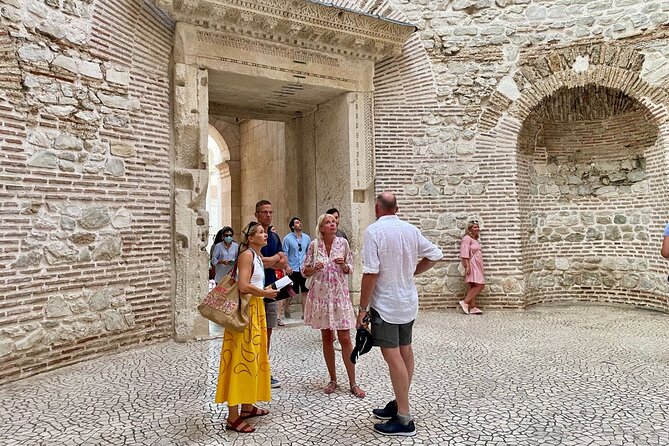
From the palace, you enter Diocletian’s cellars through the South Gate. This part is built over 1,700 years ago and is described as very well preserved. And yes, seeing a basement space in person does something that photos rarely do.
The value here is perspective. The cellars help you understand the dimensions of the palace, not just the visible walls. You start to picture the storage, the logistics, and the sheer planning that went into making this massive complex work.
When you are touring a place like this, it is easy to focus only on the dramatic public spots. The cellars nudge you back to the practical side of Roman power, which is often the most interesting part.
The peristyle, vestibule, and golden gate storyline
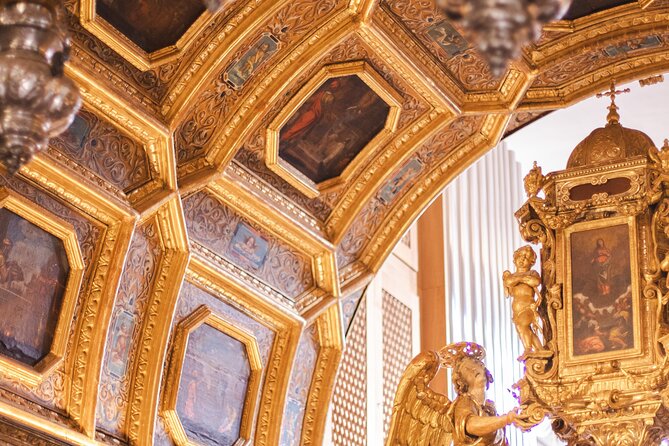
You then move through the palace’s most symbolic spaces.
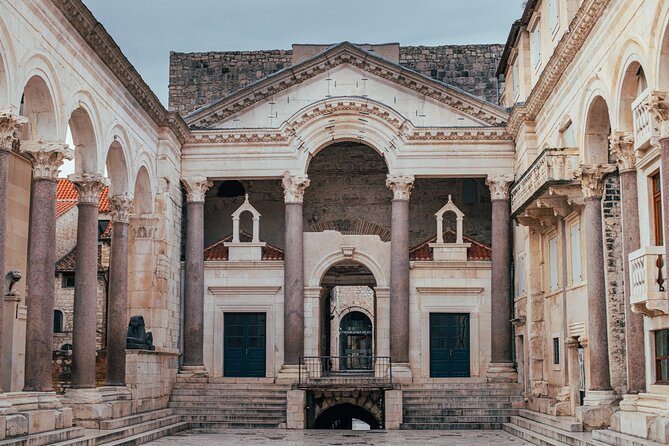
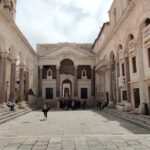
At the Peristyle, you get the sacral meeting place connected to Diocletian’s public self-presentation. Here, you are not just seeing an open courtyard. You are standing in a setting tied to worship, including the idea of Diocletian as the son of Jupiter.
Next is the Vestibulum of Diocletian’s Palace, described as the entrance area to his private chambers. That change from public to private is a key moment for understanding the palace’s design. The guide helps you read the space like a hierarchy.
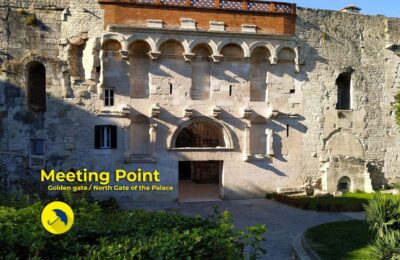
Then you reach the Golden Gate. In Roman times, this was the most important gate, and from it the road led to Salona, the capital of the Roman province. Even if you never plan to visit Salona, knowing which direction mattered gives the palace a bigger map in your head.
You can also read our reviews of more private tours in Split




Cathedral of Saint Domnius: a mausoleum turned cathedral
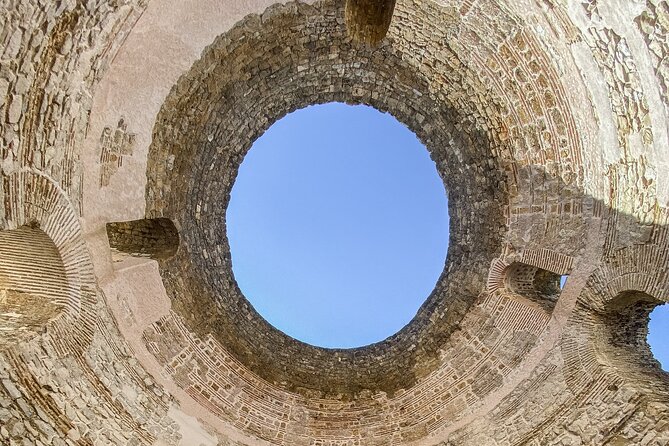
One of the best stops on the route is the Cathedral of Saint Domnius. The cathedral’s story is the kind that makes you look twice at old buildings.
It began as the mausoleum of Diocletian. Later, as Christianity spread, the pagan mausoleum became a Christian cathedral, and the coffin and remains disappeared in the process of Christianization.
This stop is included, which matters because it lets the tour focus on meaning, not ticket math. You will also get the interior linked to the wider palace complex, which helps you see the Cathedral as part of one continuous place, not a separate sightseeing detour.
Temple of Jupiter: now a baptistery with a Renaissance link
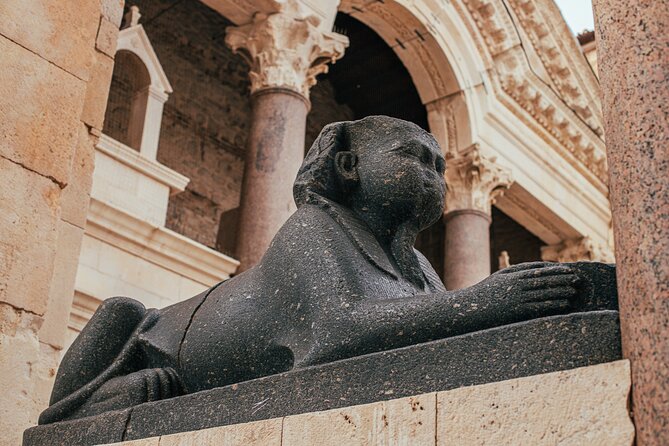
The Temple of Jupiter is another included interior stop. Today, it is a baptistery, and it is known for a beautiful casket ceiling. The design is said to have influenced Renaissance architects in Dalmatia.
This is where a good guide earns their fee. The space may look like a religious interior first, but the story ties it back to Roman worship and then forward into later European design. It is a simple way to connect centuries without making your brain do homework.
If you care about how styles travel over time, this is the kind of stop you will remember later when you see similar ceilings or design patterns elsewhere in the region.
Old Split streets: from North Gate to Narodni Trg
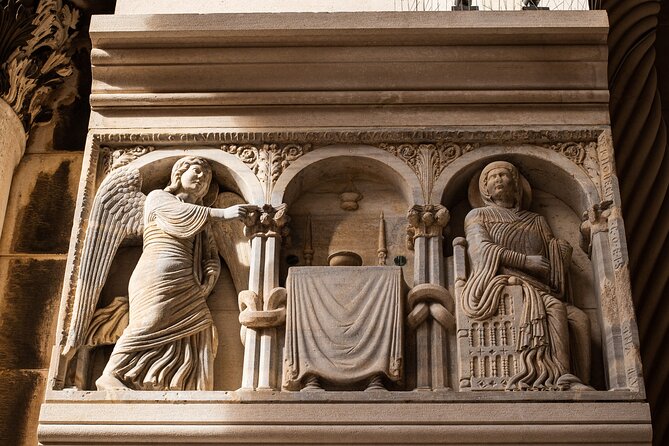
Once you pass the palace gates, the tour shifts into Old Split’s street life. You leave the interior logic of Diocletian’s complex and walk along the palace walls toward the Old Town center.
From the North Gate, you continue toward Narodni trg and then to Voćni trg, described as the former fruit market area. This part of the city developed west of the palace during the Middle Ages, so it is a nice way to see how the city grew outward from Roman foundations.
You will also make stops around the main squares:
- People’s Square (Pjaca), the center since the Middle Ages, with old Venetian palaces and an old city hall in neo-Gothic style
- Fruit’s Square (Trg Brace Radic), where today there is a monument to Marko Marulić, one of Split’s important Renaissance authors
Even in short stops, the guide keeps the context tight: what the square was, who likely used it, and why it became the center.
The fish market, sulfur baths, and the no-flies trick
At the Split Fish Market, you get one of those perfectly local sights that you might skip if you only chased famous buildings. The fish market sits next to sulfur baths, and the baths are tied to relief for rheumatism and other diseases, something Diocletian himself is associated with.
Then comes the fun detail: the sulfur smell is the reason there are no flies in the fish market. It sounds like a story, but it is the kind of practical observation that makes places feel real.
If you want your visit to include more than stone, this stop helps balance the day. It also gives you a different kind of atmosphere before the tour moves into shopping streets.
Marmontova ulica and the French-Napoleon touch
Next is Marmontova ulica, a busy shopping street and pedestrian zone in the old town. What makes it more than just a place to browse is its origin story: it was built by the French under Napoleon’s rule at the beginning of the 19th century.
This is another example of why a guided walk works. You can walk down a street like this on your own. With a guide, you understand why it looks and feels the way it does, and how later rulers left their mark here.
If you want something to do after the walk, this is a convenient transition. You are already inside the shopping and snack zone.
Ending at Procurative, a Venice-like square for lingering
The tour ends at Procurative, a square known for its cafe and restaurant pull. It is described as reminiscent of St. Mark’s Square in Venice, which gives you a quick mental shortcut if you have been there.
This ending spot is smart. It gives you an immediate payoff for the walking portion and an easy place to regroup. If you still have energy, it is a natural place to keep exploring. If you want a break with a cold drink, it is equally perfect for that.
Value and price: what $203.95 per person covers
At $203.95 per person, this is not the cheapest way to see Split. But it is a private walking tour with multiple included entry stops tied directly to Diocletian’s key sites.
The big value levers are:
- Included access to major interior experiences, including Saint Domnius Cathedral, the Temple of Jupiter, and palace basement areas
- A private, English-speaking guide who can answer questions as you walk rather than handing you audio and a route
- A route that covers both the palace and the Old Town squares, so you do not have to stitch together separate plans
Because the price is per person, it often makes more sense when you share it with companions. If you are traveling solo, it can still be worth it if you strongly prefer a tailored walk and want the included interiors without extra ticket juggling.
Also, this tour is commonly booked in advance, with an average booking lead time of 73 days. That usually means it fills up when people plan around their museum opening times, so booking sooner can protect your preferred date.
Who this tour fits best (and who might skip it)
This tour is a great fit if you want a guided walkthrough of Diocletian’s Palace and you want the context that makes the space easier to understand. If you like the mix of Roman engineering, sacred spaces, and Old Town street scenes, you will feel like you got a complete snapshot.
You might skip this if you only want exterior views and you dislike guided pacing. The time is built around entrances and stops, so solo wanderers who prefer total freedom may feel constrained.
It is also worth noting that the tour can be adapted to special needs if you inform the provider in advance. Service animals are allowed too, and it is near public transportation, which helps with getting to the meeting point.
Should you book Split Palace and Old Town?
I think this is a strong booking if your priority is understanding Diocletian’s Palace in a way that sticks. The included entries to Saint Domnius Cathedral, the Temple of Jupiter, and palace basement areas remove a common pain point, and the route continues into the Old Town squares instead of stopping at the palace gates.
Do book it if:
- You want a guided explanation while you are standing in the spaces
- You care about how the palace connects to today’s city layout
- You want a clean start and finish, with the Riva at the beginning and Procurative at the end
Skip or consider alternatives if:
- Weather is questionable, since the tour requires good weather
- You prefer purely self-paced sightseeing, because this is designed around a planned sequence
FAQ
How long is the Split Palace and Old Town private walking tour?
It runs about 2 hours 30 minutes.
Where does the tour start and end?
The meeting point is at the model of the historical core of Split, Obala Hrvatskog narodnog preporoda 23. The tour ends at Republic Square, Procurative.
Is this tour private?
Yes. Only your group participates.
What language is the tour offered in?
The tour is offered in English.
Are entrance tickets included?
Yes, entrance fees are included for the palace basement and for the Cathedral of Saint Domnius and the Temple of Jupiter. Entrance fees are also included for Diocletian’s Cellars.
What sights will you see inside the palace area?
Depending on access, you may visit the basement of the palace, the interior of the Cathedral, the Temple of Jupiter, and the cellars through the South Gate.
What happens if a sight is closed due to events or church services?
If worship or events prevent access, the guide may slightly change the program so you can still complete the tour as much as possible.
Does the tour run in any weather?
This experience requires good weather. If it is canceled due to poor weather, you will be offered a different date or a full refund.
What is the cancellation policy?
You can cancel for a full refund up to 24 hours in advance. Within 24 hours of the start time, refunds are not available.
Are service animals allowed?
Yes, service animals are allowed.
More Walking Tours in Split


More Tours in Split

More Tour Reviews in Split

Not for you? Here's more nearby things to do in Split we have reviewed






More Split City & Day Tours to consider.
 ★ 4.8Krka Waterfalls Trip with Boat Cruise and SwimmingFrom $3110,519 reviews
 ★ 5.0Krka Waterfalls, Food & Wine Tasting TourFrom $459,326 reviews
★ 4.9Krka Waterfalls, Food & Wine Tasting TourFrom $446,598 reviews
★ 5.0Krka Waterfalls, Food & Wine Tasting TourFrom $459,326 reviews
★ 4.9Krka Waterfalls, Food & Wine Tasting TourFrom $446,598 reviews
 ★ 4.6Split/Trogir: Blue Cave, Mamma Mia, Hvar and 5 Island TourFrom $1096,320 reviews
 ★ 4.5Blue Lagoon & 3 Islands Cruise with Lunch from SplitFrom $785,756 reviews
 ★ 4.9Old Town and Diocletian Palace Walking TourFrom $174,727 reviews
 ★ 4.9Blue Lagoon Boat Party with DJs, Shots & After PartyFrom $474,610 reviews
 ★ 5.0Krka Waterfalls Tour, Boat Cruise & SwimmingFrom $324,489 reviews
Explore its other useful categories