
REVIEW · SPLIT DIOCLETIAN'S PALACE & HERITAGE TOURS
Split Diocletian Palace Highlights – Private walking tour
A palace that you can still walk through. Split’s Diocletian’s Palace is a Roman complex that still feels alive, because homes, shops, and everyday life sit right inside the walls. I love that this tour keeps you moving, so you get a clear sense of the palace layout without spending your whole day stuck in lines.
What I like most is the focus on the big, recognizable features, like the cellars and the Peristyle, and then connecting them to what you actually see outside. One thing to consider: this is an outside-only experience, so you won’t be going inside the cathedral or other enclosed spaces.
Key highlights you can expect
- A small private group designed for up to 6 people, with a stated maximum of 10 travelers
- Outside-only viewing, so you skip entrance fuss and keep your timing tight
- Roman-to-Christian change on display, from Diocletian’s mausoleum to Saint Domnius
- Food history you can picture, including the triclinium dining room story
- Gates and markets right in the route, including the Green Market and Pjaca square
Split Riva to Diocletian’s walls, the walk starts with real life
Your tour begins at the Model of the historical core of the city of Split, on Obala Hrvatskog narodnog preporoda 23. It’s a smart starting point because it puts you near the water right away, so the whole day feels grounded in modern Split, not just ruins.
The first stop is the Split Riva, the palm-lined promenade where locals and visitors mix in the sun. This is not where you learn Roman details. It is where you get bearings, notice the pace of the city, and understand why people come to Split in the first place: it’s a lived-in coastal place with history stacked on top.
Then the tour pivots from the waterfront mood into the palace world. The key advantage here is that you transition quickly, while you still have energy to pay attention. In 90 minutes, that matters.
Diocletian’s Palace, not a museum, and why you’ll feel the scale
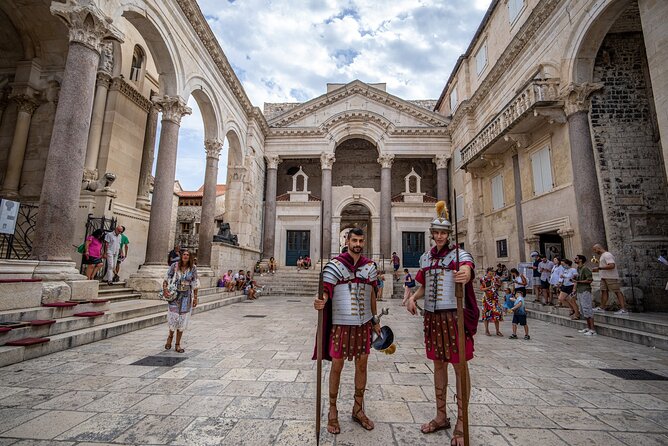
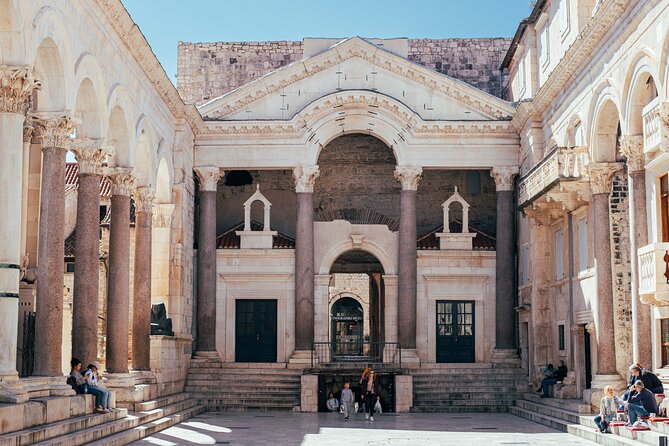
Diocletian’s Palace is the backbone of Old Town Split. It was built and inhabited by the Roman emperor Diocletian more than 1700 years ago, and today it is not a museum in the usual sense. Inside the palace walls, you’ll find houses, stores, and constant activity.
That approach changes how you understand the complex. Instead of treating the palace like a set of sealed-off artifacts, you start seeing it like infrastructure. Roman power built something functional, and later generations kept using it. When your guide helps you read the space, the walls stop being distant and start becoming “how the city works.”
The tour highlights the palace from the outside, so you’re not chasing doorways or waiting for entry tickets. That’s a practical way to see the most famous parts fast, especially if your schedule is tight.
You can also read our reviews of more walking tours in Split


Cellars and the palace dimensions you can actually grasp
From the south gate, you step toward Diocletian’s cellars. These cellars are also more than 1700 years old and are described as very well preserved. Even viewed from the route, the cellars give you something many palace visits miss, a sense of scale.
Here’s what I find useful: cellars are where big structures show their true weight. They hint at supply, storage, and the logistics behind running a palace of that size. So when you later look at the higher walls and formal spaces, you have a more believable mental picture of what supported everything.
This stop is short, about 5 minutes, but the payoff is high because it gives you perspective before the tour moves into ceremonial spaces.
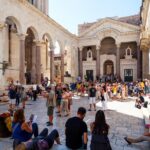
The Peristyle, where the emperor performed power
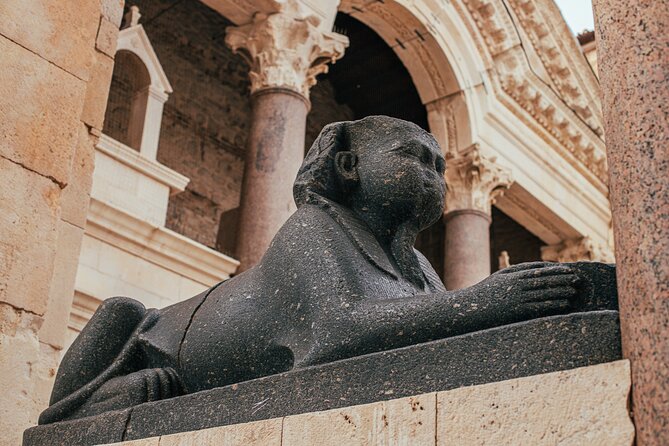
Next up is the Peristyle, the sacral meeting place in Diocletian’s time. The Peristyle is tied to display and ceremony, and this tour explains it that way: Diocletian showed himself to his subjects there and had himself worshipped as the son of the Roman god Jupiter.
You don’t need to see it inside to grasp what the Peristyle was for. Your job is to look at the geometry and imagine movement and gathering. If you like Rome as theater, this stop scratches that itch.
The Peristyle also helps you understand why the palace layout feels structured. Even without entering, you’re being guided to connect the “public performance” spaces with the areas that were more private, like the next stops in the tour.
Saint Domnius and Jupiter’s temple, Roman and Christian layers in one route
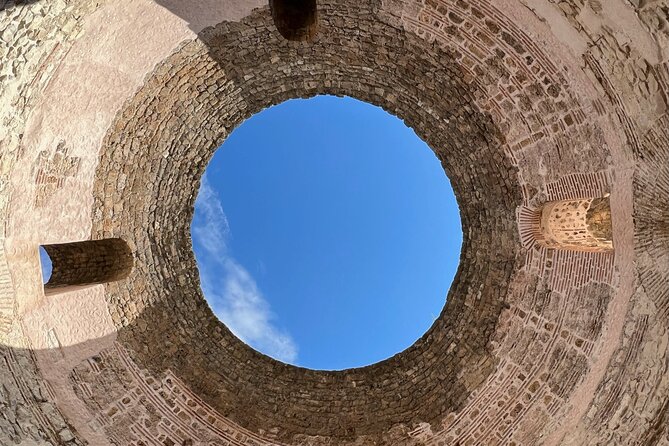
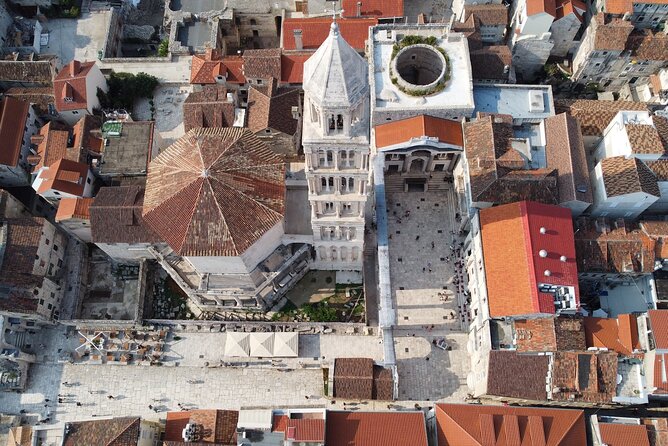
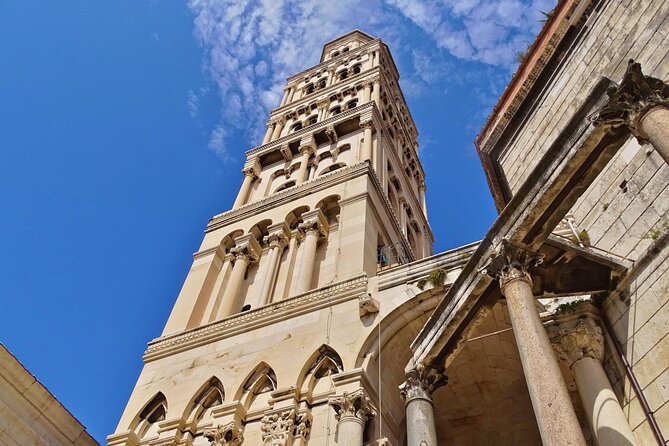
Split’s Cathedral of Saint Domnius matters because it connects two belief systems in one building story. For a time, it served as the mausoleum of Diocletian. Later, as Christianity spread, the coffin and mortal remains disappeared, and the pagan mausoleum became a Christian cathedral.
In this tour, you look at the cathedral from the outside only. That can feel limiting if you want interior details, but it still delivers value. The street-level view is enough to anchor the transformation story in a real, standing landmark.
The tour also points you to the Temple of Jupiter, which is now used as a baptistery. Again, this is an outside look. Still, it’s one of the most effective ways to notice how churches reuse older sacred spaces. If you enjoy tracing cultural shortcuts and repurposing, you’ll appreciate the quick comparisons your guide draws between these sites.
Gates, markets, and the smart way to end near Pjaca
Split’s palace gates are more than dramatic entrances. They are also clues for how the Romans controlled movement and how later Split turned those same passages into community spaces.
On the east side, the Silver Gate is mentioned as the east gate of the palace. It was walled up several times over the centuries and reopened in the 1940s. Today, it leads toward the market area where local products are offered. That’s a practical pairing for an outside-only tour, because it keeps you close to daily life while still staying inside the palace story.
Later, you visit the Iron Gate on the west side. This is where the tour adds a bit of military realism. It was built as a double gate, called a Propugnaculum, so an enemy could be trapped between the two gates and attacked with stones, arrows, and hot oil. Even if you have no interest in siege tactics, you’ll get a clearer sense of why the palace walls feel like fortifications.
Leaving the gate leads you into the beautiful square Pjaca. Then the tour also includes the Golden Gate, the north gate of the palace, described as the most important in Roman times. From there, the road led to Salona, the capital of the Roman province. That detail gives you a sense that this palace was not isolated. It was connected to the wider Roman world.
Finally, you loop into the Green Market area on the east side of the palace, where fresh fruits, vegetables, and other traditional foods are sold daily. This is about more than shopping. It’s your evidence that the palace area is still an active part of Split, not a dead zone turned into a backdrop.
You finish back at the Split Riva area, following the palace walls toward the promenade again. It’s a nice emotional full circle. You return to the same kind of sunlit public space where you started, but now the old stones make sense.
You can also read our reviews of more private tours in Split



Triklinij, the dining room story that brings stones to life
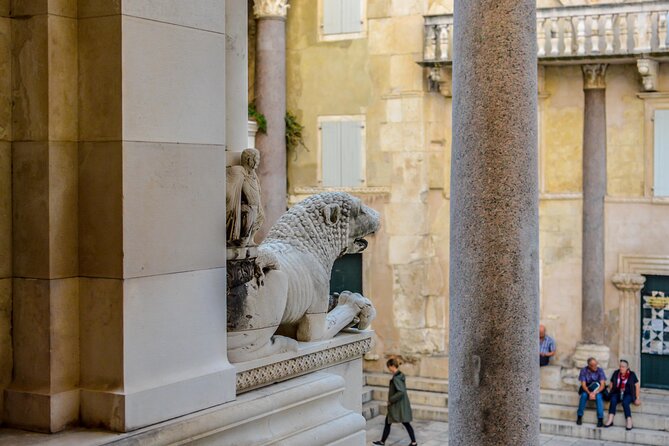
One of the most fun stops is the Triklinij, a Roman term meaning dining room. This is the place where Diocletian dined with guests, and the tour gives you specific food vibes, not vague Roman-generalities.
On the table were mainly Mediterranean dishes. You also get a clear reminder that wine and fish were popular, and that honey was also very common. The tour even shares the image of high-end feasts, with evenings that could include up to 20 different courses.
Even though you only look from the outside, this stop is surprisingly effective. Food details are a shortcut to imagining how people experienced the palace. You don’t have to study architecture to feel the contrast between a formal dining setting and everyday modern street life outside.
Vestibulum and the private chambers, where the emperor kept distance
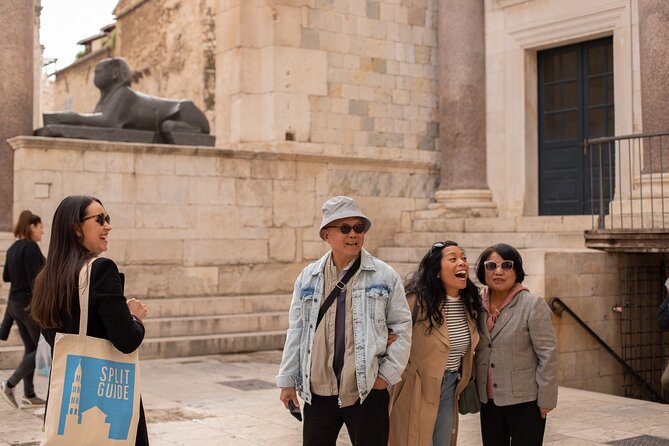
The tour also includes the Vestibulum of Diocletian’s Palace, described as the entrance area to Diocletian’s private chambers. This is a small stop, but it matters because it helps you separate public and private spaces.
When you start noticing which areas were meant for display and which were meant for control, the palace stops being one big “wow” and starts becoming a set of purposes. That is the real value of a structured guided walk: it teaches you how to read the layout like a map.
If you’ve ever visited ruins and felt lost about where people went and why, this is the piece that fixes that feeling.
Who gets the most out of this private walk?
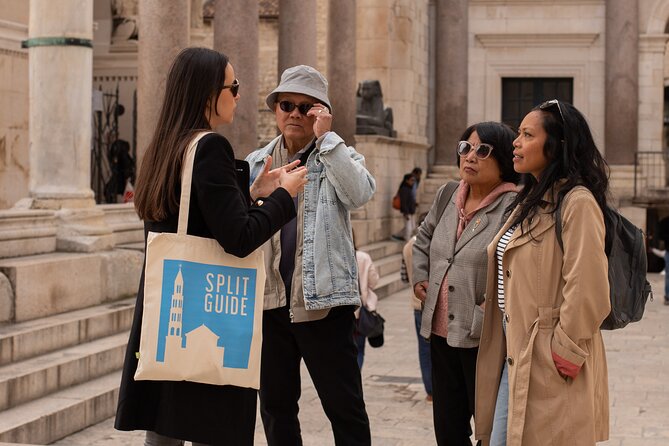
This is designed for a small group, and it is private in the practical sense that your pace and focus are easier to control with fewer people around. It is offered in English and lasts about 1 hour 30 minutes.
You’ll likely enjoy it most if:
- You want the high points of Diocletian’s Palace without spending half a day navigating
- You like having the story explained in plain terms as you walk
- You want practical help afterward, since the tour includes recommendations for restaurants, bars, and leisure activities
- You appreciate customization, since it can be adjusted for your needs if you tell the provider in advance
One review also praised a guide named Dana for sharing lots of history and stories in a way that clicked. Even if your guide is someone else, that kind of narrative clarity is the best sign you’ll get from this format.
Price and value: what $137.80 per person really buys
At $137.80 per person, you are paying for time, structure, and interpretation, not for museum tickets. The tour is explicitly outside-only, so there are no entrance fees for the sights visited on the route.
Here’s why that can be good value. In Split, time is expensive because you’re walking through dense Old Town, and lines and interior access can eat into your day. By focusing on key exterior points like the Peristyle, cellars, and major gates, you get a guided “mental map” you can use on your own later.
You’re also paying for a small group format and built-in extras: recommendations for where to eat and what to do next. That matters in a place where good choices are not always obvious at first glance.
The only real drawback on the value side is the outside-only limitation. If your dream is to spend hours inside museums and chapels, this won’t replace that. But if your goal is to understand the palace fast and walk it confidently afterward, the price feels easier to justify.
Timing and practical tips for an outside-only route
This is a walking tour with a set route and short stops, and it requires good weather. That’s important in Split, because rain can turn cobblestones into a skating rink and can also make outdoor viewing less comfortable.
A few practical tips:
- Wear shoes with grip. Old Town surfaces can be uneven.
- Bring water and something light for sun, since the route begins at the Riva and then spends time in open spaces.
- Expect a story-forward pace. The stops are around 5 to 15 minutes each, so listen for the connections between places, not just the individual facts.
Because you’re not paying entrance fees for these stops, you won’t lose time inside. But you also won’t get interior details. If you want those, you can pair this walk with a separate plan later.
Should you book this Split Diocletian’s Palace walking tour?
Book it if you want a smart, efficient way to understand Diocletian’s Palace and Old Town Split in about 90 minutes. The outside-only format is a feature, not a bug, because it keeps you moving, avoids ticket friction, and gives you a guided framework you can use immediately afterward, especially around Pjaca, the markets, and the gates.
Skip it or consider a different option if your priority is going inside major interiors for long periods. This tour is designed for quick, exterior viewing with interpretation, not for deep museum time.
If you’re short on time, this private walk is one of the most practical ways to get oriented and feel the layers of Roman and later Christian life without turning your trip into a checklist.
More Walking Tours in Split


More Tours in Split

More Tour Reviews in Split


Not for you? Here's more nearby things to do in Split we have reviewed






More Split Diocletian's Palace & Heritage Tours to consider.
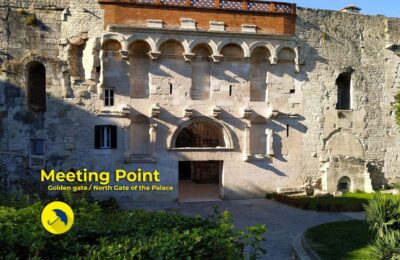 ★ 4.9Old Town and Diocletian Palace Walking TourFrom $174,727 reviews
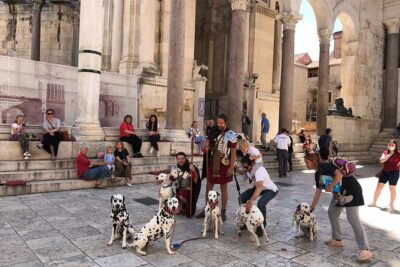 ★ 5.0Walking Tour of Split and Diocletian’s PalaceFrom $482,588 reviews
 ★ 5.0Split & Diocletian’s Palace Walking TourFrom $211,125 reviews
 ★ 4.7Diocletian Palace & Old Town Guided Walking TourFrom $17882 reviews
 ★ 4.8Game of Thrones Tour with Diocletian’s Palace CellarFrom $41545 reviews
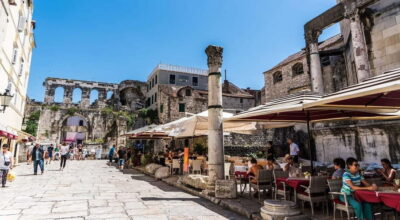 ★ 5.0Diocletian’s Palace and Old Town SMALL GROUP Walking TourFrom $16502 reviews
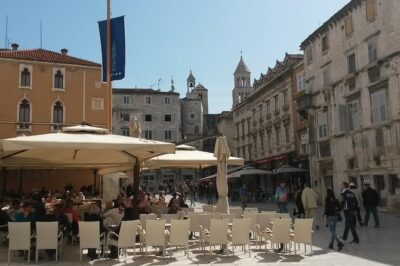 ★ 5.0SPLIT-PRIVATE Walking Tour of Diocletian’s Palace & Old TownFrom $240467 reviews
 ★ 5.090-min Diocletian Palace Walking TourFrom $21323 reviews
Explore its other useful categories