
REVIEW · SPLIT CITY & DAY TOURS
Private History Split Walking Tour in Spanish
Diocletian’s Palace is easier with a guide. This private Spanish walking tour walks you through the palace’s key spaces and the city stories that grew out of them, in about 1 hour 30 minutes. You get an educated guide who explains what you’re seeing in plain language, and the Spanish is strong enough to follow every detail without straining.
Two things I like a lot: the tour is built around the big “you must see this” landmarks like the Peristyle and the Golden Gate, and it connects those stones to real cause and effect, how one man’s power shaped an entire city. One consideration: the route is not built for travelers who struggle with high steps, since old-stone surfaces can mean uneven footing and stairs.
Key highlights worth caring about
- Private group pace, just your group on the route
- Spanish-language storytelling that stays clear and question-friendly
- Peristyle to Golden Gate route, so you get the palace layout fast
- Substructures focus, plus a note that the museum part is optional afterward
- Riva and Split’s promenade roots, tied directly to Diocletian’s Palace
- Marko Marulić and Gregory of Nin, where history shows up in language
A private, Spanish-language walk through Split’s Roman core
If you only have a little time in Split, you still want more than photo stops. This tour is designed for quick orientation inside Diocletian’s Palace, then smart connections outward into the older city areas right around it. Since it’s private, you do not get stuck waiting for other groups, and you can ask your guide to repeat or clarify as you go.
The language matters here. This is a Private History Split Walking Tour in Spanish, and the guide’s Spanish quality comes through in how calmly they answer questions. That is not just comfort, it also changes what you notice, because you can track the ideas instead of guessing what the guide means.
The other thing I appreciate is the balance between “what is this place” and “why it mattered.” You’ll hear how Diocletian went from a nobody to the most powerful man in the world, and how that kind of power leaves physical traces you can still read today.
You can also read our reviews of more walking tours in Split

Where the tour starts: Peristil ulica and the Peristyle square
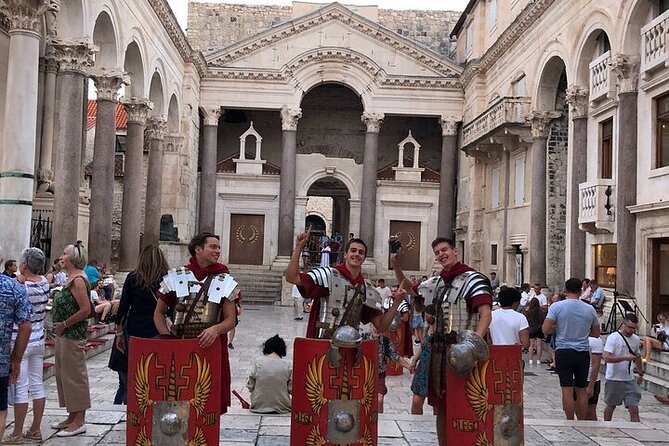
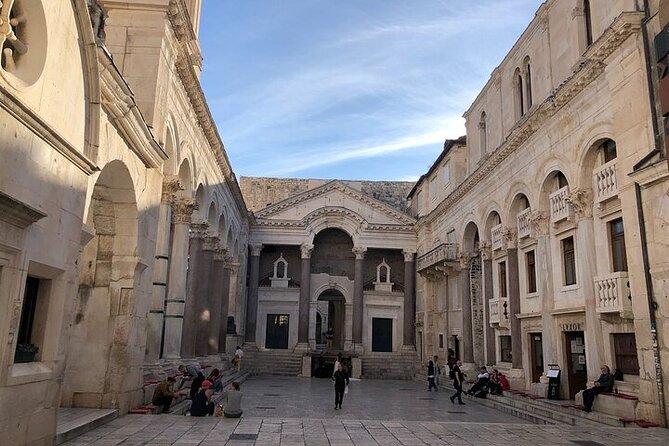
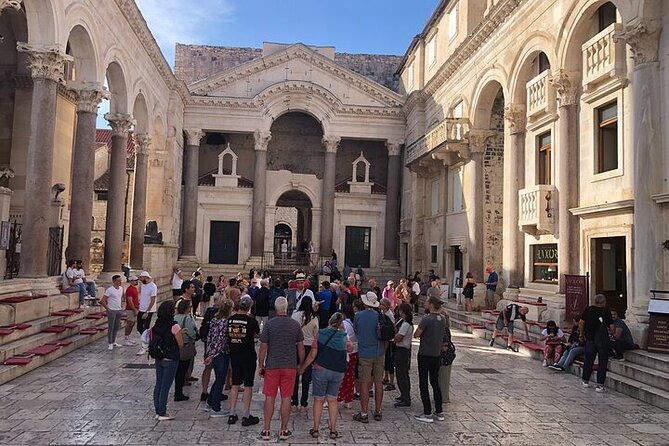
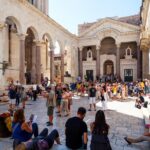
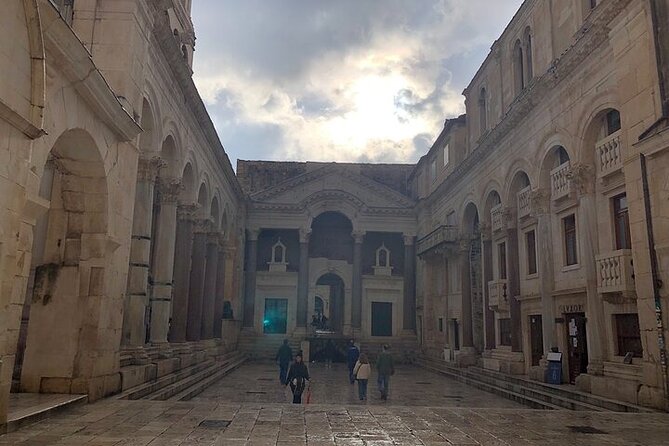
You meet at Peristil ulica (Peristil ul., 21000, Split), and the tour begins right where most of the palace story makes sense: at the Peristyle. This is the central square of Diocletian’s Palace, the kind of spot that helps you understand the palace layout, because from here you can reach almost all other parts within the complex.
At this first stop, the guide’s job is mostly interpretation. You’re not just seeing an open courtyard. You’re learning how Diocletian’s project worked as a palace-city idea, built for control and status. If you have walked into Split on your own, you may feel like the palace is a maze of arches and passages. Start here and the logic starts clicking faster.
Practical tip: even though the tour is short, you’ll do a lot of “look up, look around, listen, then connect the dots.” Comfortable shoes help, because you are on real stone floors in a historic area.
Jupiter and the palace idea: learning the symbolism behind the walls
After the Peristyle, you get context for a Roman layer many visitors miss. You’ll learn about the Roman temple of Jupiter, and specifically the idea that Diocletian saw Jupiter as his divine father.
This is one of those stops that changes how you look at the whole palace. If you only think in terms of architecture, you might see monuments as decoration. Hearing how rulers used religion and symbolism gives you a reason for where certain elements sit, and why they would have mattered to the people moving through these spaces.
It also sets up a theme the guide keeps returning to: power in the ancient world was not only armies and money. It was also the story of legitimacy.
The Diocletian substructures: function over flash, plus optional museum time
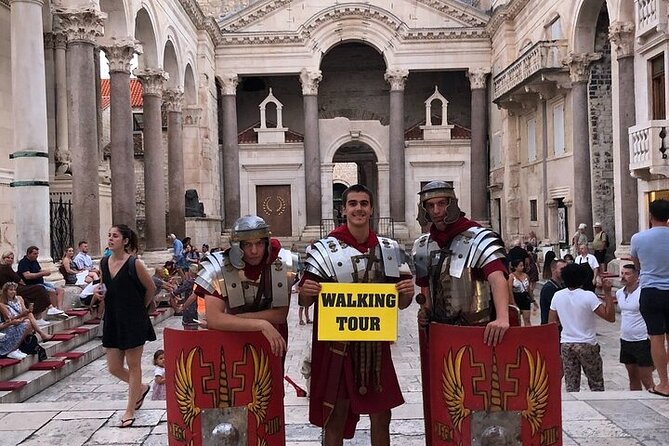
One of the best ways to understand Diocletian’s Palace is to learn what’s underneath the showy surfaces. You’ll go through the Diocletian Palace substructures, where the guide explains the history of their construction and how they were used, then how their role shifted over the ages.
A key detail: you will not visit the museum part of the substructures during this tour. That is actually a good setup. You get the core walk and explanation now, and if you want more after, you can add the museum time when you are ready. If you are trying to see many things in Split, this keeps the tour focused.
What to watch for: substructures can feel like “just corridors” if you do not know what you’re looking at. Let the guide tell you the purpose, because that’s when they turn from empty passageways into a system that made the palace work.
If you love Roman engineering, you’ll likely enjoy this segment the most, because the story is very practical: how spaces were built, used, and then repurposed as the centuries turned.
Golden Gate and the statue of Gregory of Nin
Next comes the Golden Gate, described as the main entrance of Diocletian’s Palace. This is where you get a strong “arrival point” feeling, because it’s the kind of entrance people would have experienced as they entered a powerful place.
The tour also includes a statue of Gregory of Nin, with a guided explanation of his importance to history and even language. That last part is a good reminder that heritage in Split is not only Roman. It is Roman foundations, then layers of later culture built on top.
You’ll get more from this stop if you do two things: look at the gate as a boundary, and listen to how the guide connects Gregory of Nin to how people understand themselves over time. When you make that mental link, the palace becomes less like an archaeological site and more like an ongoing cultural story.
You can also read our reviews of more private tours in Split


Riva Harbor and the bronze model of the palace
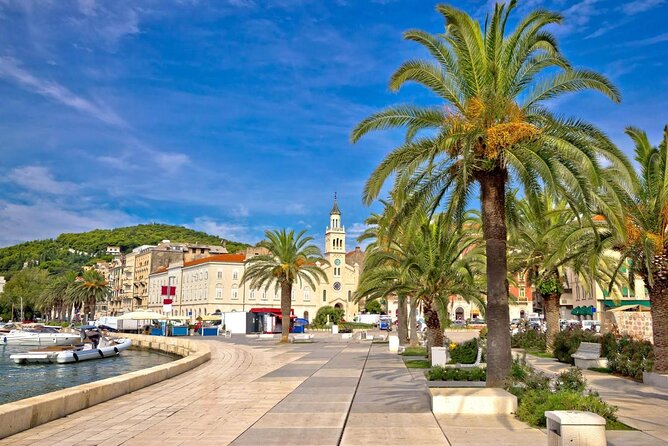
Then you shift toward Riva Harbor, where you’ll see a bronze model of Diocletian’s Palace. This is a smart move. A bronze model can feel like a detour if you expect “walk and talk” only. But here, it acts like a map you can hold in your head while you keep exploring.
You’ll also learn about the history of Split’s Riva promenade, and how it connects back to the palace setting. The result is a tour that helps you understand why Split looks and feels the way it does, not just what happened there long ago.
If you plan to spend time after the tour lingering by the water, this stop gives you useful context so you’re not just staring at scenery. You’re reading the city.
Fruit’s Square and Marko Marulić: Venetian power meets Croatian literature
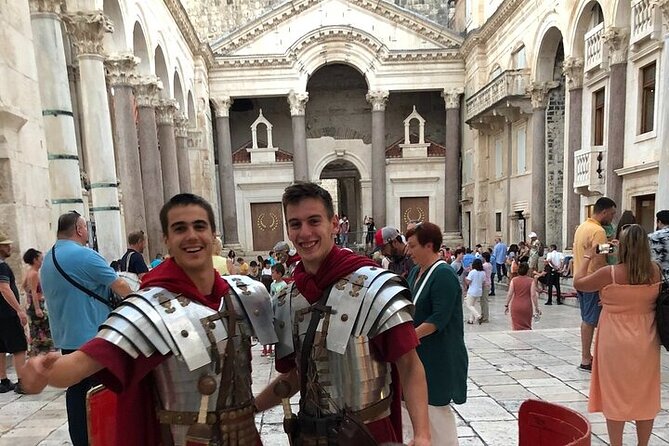
From the harbor area you go to Fruit’s Square (Trg Brace Radic). Here the guide talks about a 15th-century Venetian citadel and brings in Marko Marulić, described as the father of Croatian literature.
This is a great example of why I think a “history tour” works better than a “landmarks tour.” You are not only learning which power ruled when, you’re also seeing how cultural identity took shape. A Venetian citadel connects you to the strategic importance of the Adriatic. Marko Marulić connects you to the idea that language and writing mattered too.
If you like being able to tell friends something specific, this stop gives you two clear anchors: the Venetian fort influence, and Marko Marulić as a major literary figure.
What you might consider: this part is short, so if you want deeper study, keep your questions flowing. A private guide is good for that.
Split Synagogue and the Jewish story in the city
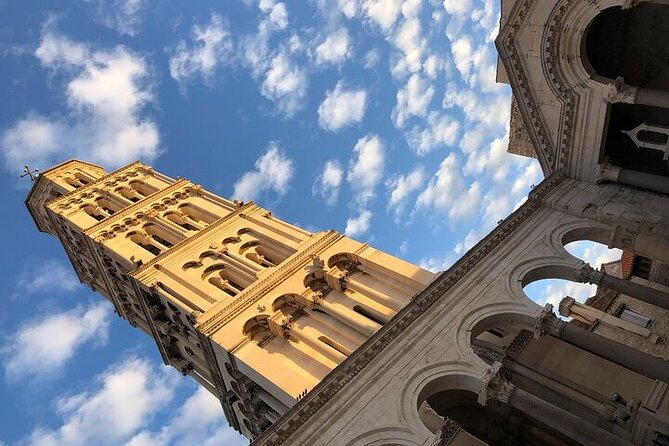
The tour passes by the Split Synagogue, a 16th-century building. You’ll learn about the history of the Jewish people in Split. The tour data notes that admission ticket for this stop is not included, so you may only pass by rather than enter, depending on how you choose to experience the synagogue itself.
Even if you do not go inside, passing by still matters. It interrupts the common “only Romans” storyline and reminds you Split has been shaped by multiple communities for centuries. If synagogue history is important to you, plan to budget extra time if entry is an option, but do not assume it is part of the included tour.
Vestibulum of Diocletian’s Palace and the possibility of singing
One of the most atmospheric parts of the route is the Vestibulum of Diocletian’s Palace. Here you’ll see the vestibule of emperor Diocletian and hear the history behind it, and you might even hear traditional Dalmatian singing.
That potential moment is worth noting because it’s exactly the kind of “small but real” cultural texture you want on a short visit. Even if you do not catch singing that day, the guide’s focus on the space and its meaning should still land.
This stop is also a reminder that Diocletian’s Palace is not only a static monument. It is a living backdrop for a city that still uses these ancient corridors and thresholds in everyday life.
Revisiting the substructures: why the route makes sense
After the vestibule area, the tour goes back through the Diocletian Palace substructures again. That can sound repetitive, but in practice it often helps you absorb what you learned earlier. You notice details more when you have a sense of the bigger story, and hearing construction and function explained once, then reorienting as you walk, can make the space click.
Since you are staying within the palace zone, you also avoid the time-cost problem of switching between far-apart attractions. It keeps the tour efficient, which matters when the whole experience is around 90 minutes.
Price and value: is $63.05 for 90 minutes a fair deal?
The price is listed at $63.05 per person, and the tour is private, with group discounts available. That combination can be a good value if you care about two things: speed and personalization.
Ninety minutes is not long. In a group tour, you might get a quick glance and a hurried explanation. In a private format, you tend to get better pacing, clearer Q and A, and more time spent understanding what you’re seeing, like what the substructures were for, or why the Golden Gate and Gregory of Nin matter beyond just being pretty.
You can also think about this as a “content per hour” purchase. You get multiple palace highlights, plus context about Jupiter, the later Venetian layer, Marko Marulić, and the synagogue story. If that kind of storyline is what you want, the price is easier to justify.
One more practical point: this tour offers a mobile ticket. For a short walk, that saves friction and keeps you focused on the streets, not the paperwork.
Timing, logistics, and how to plan your day around it
The tour lasts about 1 hour 30 minutes and ends not far from where it started. The guide can take you back to the Peristyle area if you ask. That’s useful if you are planning lunch or if you want to keep exploring the palace zone on your own afterward.
It is also near public transportation, so you can fit it into a normal walking and transit day. The meeting point is specific, Peristil ulica, so give yourself a little buffer to arrive on time, especially if you are juggling multiple stops in Split.
Accessibility note from the tour data: it’s not recommended for travelers who have issues with high steps. If your mobility needs are sensitive, you should take this seriously and consider a different route.
My simple planning advice: schedule this early in your time in Split. Getting the palace layout and the big story first makes everything after feel more coherent.
Who this tour fits best
This is a strong match for people who want:
- A Spanish-language explanation of Diocletian’s Palace and what shaped Split
- A quick, structured route that hits major highlights without wasting time
- Clear storytelling about Roman power, then later layers like Venetian influence and the Croatian literary connection
It may be less ideal if you:
- Struggle with high steps or uneven historic surfaces
- Prefer very slow, in-depth museum-style browsing, since this tour does not include the substructures museum part
If you like history that connects architecture to real decisions people made, you will probably feel satisfied by the way the guide ties themes together: power, legitimacy, adaptation over time, and language.
Should you book this Spanish private history walking tour?
I’d book it if you want to get oriented inside Diocletian’s Palace fast, and you care about understanding the “why” behind what you see. The private setup plus the guide’s clear Spanish makes the experience easier to follow, and the route covers a smart spread of key moments, Peristyle, Golden Gate, Riva model context, Marko Marulić at Fruit’s Square, and the synagogue pass-by.
I’d hesitate only if stairs are a problem for you, because the tour is in a historic palace setting where footing and steps are part of the deal. If that is not an issue, this is a solid way to spend 90 minutes and come away with a connected picture of Split, not a pile of disconnected photos.
FAQ
What is the duration of the Private History Split Walking Tour in Spanish?
The tour lasts about 1 hour 30 minutes.
Where does the tour start, and where does it end?
It starts at Peristil ulica (Peristil ul., 21000, Split, Croatia) and ends at Diocletian’s Palace area (21000, Grad, Split, Croatia). The tour ends not far from the start, and the guide can take you back to the Peristyle if you ask.
Is this tour private, or do I join other groups?
This is a private tour/activity. Only your group will participate.
Are admission tickets included?
No admission tickets are included in the price. The tour notes that some stops have free admission, but the synagogue admission is not included.
Will the guide be speaking Spanish?
Yes. This is a Private History Split Walking Tour in Spanish, and the guide explains the sites in Spanish.
Is the tour suitable if I have trouble with steps?
It is not recommended for travelers who have issues with high steps.
Can I cancel for a full refund?
Yes, you can cancel up to 24 hours in advance of the experience for a full refund. If you cancel less than 24 hours before the start time, the amount paid is not refunded.
More Walking Tours in Split
More Tours in Split

More Tour Reviews in Split

Not for you? Here's more nearby things to do in Split we have reviewed




More Split City & Day Tours to consider.
 ★ 4.8Krka Waterfalls Trip with Boat Cruise and SwimmingFrom $3110,519 reviews
 ★ 5.0Krka Waterfalls, Food & Wine Tasting TourFrom $459,326 reviews
★ 4.9Krka Waterfalls, Food & Wine Tasting TourFrom $446,598 reviews
★ 5.0Krka Waterfalls, Food & Wine Tasting TourFrom $459,326 reviews
★ 4.9Krka Waterfalls, Food & Wine Tasting TourFrom $446,598 reviews
 ★ 4.6Split/Trogir: Blue Cave, Mamma Mia, Hvar and 5 Island TourFrom $1096,320 reviews
 ★ 4.5Blue Lagoon & 3 Islands Cruise with Lunch from SplitFrom $785,756 reviews
 ★ 4.9Old Town and Diocletian Palace Walking TourFrom $174,727 reviews
 ★ 4.9Blue Lagoon Boat Party with DJs, Shots & After PartyFrom $474,610 reviews
 ★ 5.0Krka Waterfalls Tour, Boat Cruise & SwimmingFrom $324,489 reviews
Explore its other useful categories