
REVIEW · SPLIT CITY & DAY TOURS
Private History Split Walking Tour in Italian – Small group
Rome is under your feet in Split. This small-group, Italian-led walk threads together Diocletian’s Palace and Split’s later layers in about 90 minutes. You’ll leave with a clearer map in your head, and a better sense of how one powerful Roman figure shaped a whole city.
I love the way the guides connect details to the bigger story of Diocletian, the man who rose from nowhere to ruling the world. I also love that the experience is led by strong Italian speakers, with guides like Doris and Maria specifically mentioned for how prepared and helpful they are.
One possible drawback: the tour is tightly paced, so you do not visit the museum portion of the palace substructures. You’ll learn a lot, but you will not linger in the exhibits.
Key highlights to look for
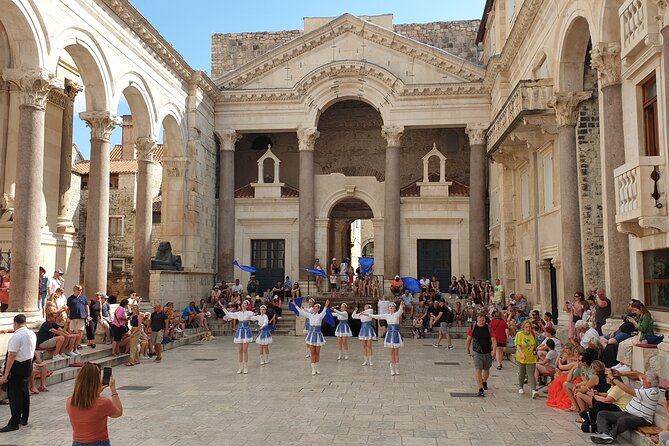
Peristyle first, so you get oriented fast inside the palace walls
Vestibulum stop, with a chance to hear traditional Dalmatian singing
Substructures walkthrough, focusing on how the palace was built and used over time
Golden Gate + Gregory of Nin, where you learn why this statue matters to language and identity
Riva Harbor model view, a practical way to visualize the palace
Split Synagogue pass-by, a brief but meaningful look at the city’s Jewish presence
Diocletian’s Palace, explained in Italian for a 90-minute reset
This tour is built for people who want the headline story of Split without getting lost. You’re not trying to read every stone yourself. Instead, you get a focused walk through the key palace areas, explained in Italian by a guide who can actually keep the thread going.
What makes it especially useful is the pacing. You move through the palace and the nearby old-town spaces in a way that helps you understand how the Roman fortress became a living city. The guide’s storytelling centers on Diocletian’s rise, which turns a bunch of impressive ruins into a believable sequence of power, design, and survival.
You’ll also appreciate the small-group vibe. Even when the route stays compact, it tends to feel personal enough to ask a question or get clarification. That matters in a place like Split, where street angles and wall passages can make a simple “walk this way” plan feel confusing.
You can also read our reviews of more walking tours in Split

Price and value: what $69.39 gets you in Split
At $69.39 per person, this isn’t a budget lottery ticket, but it also isn’t priced like a private “escape room with history.” For your money, you’re paying for two things: a well-educated guide and time saved by not guessing what matters.
Think about what you’d otherwise need to do on your own:
You’d spend extra time figuring out where the most important palace spaces are.
You’d need more background to connect Peristyle, gates, corridors, and the later city around it.
You’d likely miss some of the human details, like why Gregory of Nin shows up and what the Golden Gate represents.
Here, those pieces are bundled into a single walk that ends back near where you start. That’s real value when you only have one day (or you want a history anchor before wandering on your own).
The tour also uses a mobile ticket, which is a small but practical convenience once you’re standing in the old streets of Split with limited patience for paperwork.
Start at the Peristyle, where you get your mental map
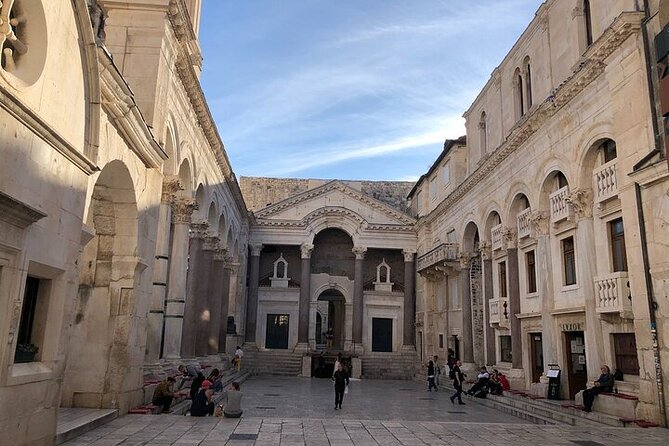
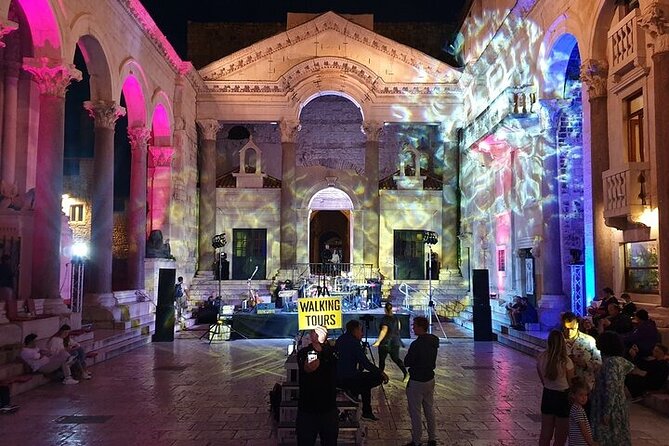
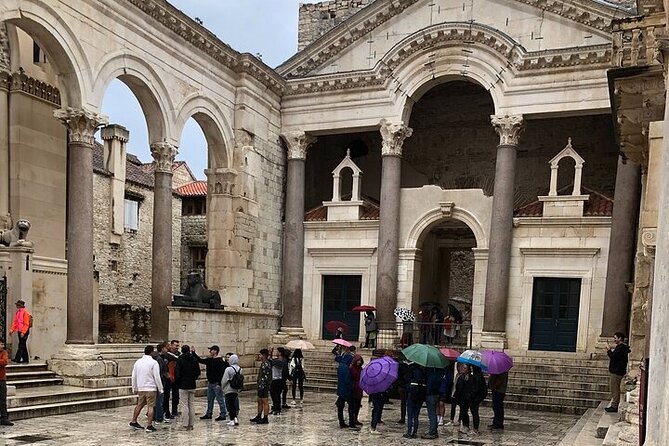
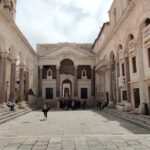
Your first stop is the Peristyle of Diocletian’s Palace, the central square that connects to many other locations. This is the right place to begin, because it gives you orientation. Once you see how the space works, the rest of the palace stops feeling like a maze.
In plain terms, the Peristyle is where you learn the layout logic. The guide can point out sightlines, movement, and what the space was meant to do in Diocletian’s world. Even if you’re not an architecture person, you’ll feel the difference once you understand why the palace is arranged the way it is.
I like that this stop is short. It prevents the tour from becoming a slow lecture in a single spot. You get the framework, then you move on while the palace is still “fresh” in your mind.
Vestibulum stop: emperor’s space and a cultural moment
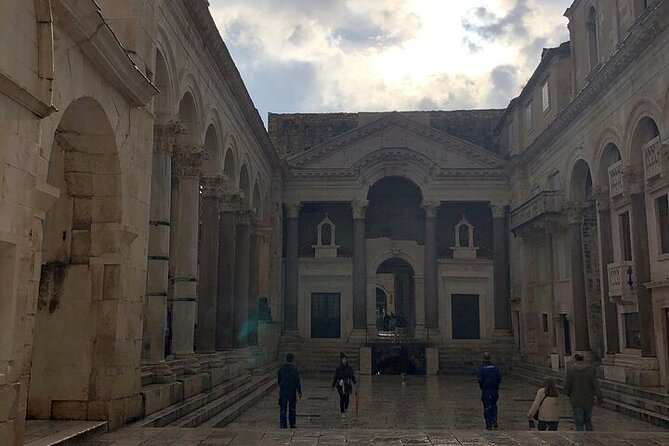
Next comes the Vestibulum, linked to emperor Diocletian. This is a smaller area than the Peristyle, but it’s the kind of stop that adds depth. You’re not just looking at walls. You’re learning what you’re looking at and why it mattered.
The best part is the chance for traditional Dalmatian singing. You might hear it during the visit, depending on the moment. Even without perfect conditions, the stop helps you see how local culture and Roman architecture share space in Split.
Practical note: because it’s a pass-through kind of moment, don’t expect long sitting time. This is a stop for attention and context, then onward.
Substructures walkthrough: construction, function, and change over time
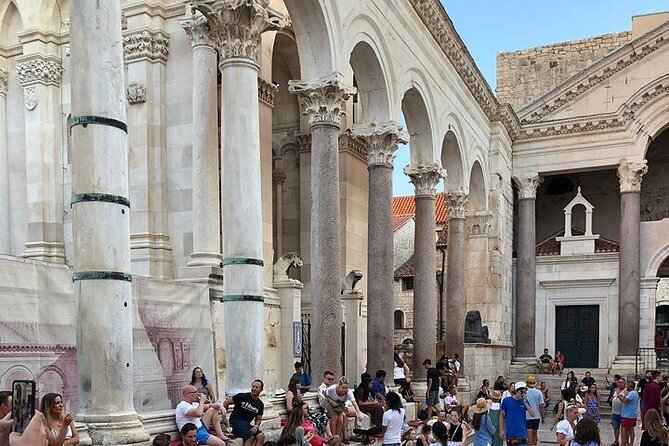
After that, you go through the palace substructures. This is one of the most interesting segments if you like the “how it worked” side of history.
You’ll learn about:
how the substructures were constructed
what their function was in the palace system
how those roles could change as the centuries passed
The key practical detail is that you do not visit the museum portion during the walk. That means you’re getting guided interpretation, not a full museum experience. If you enjoy stepping into exhibits and reading every panel, you’ll probably want to come back for the museum later.
Still, as a one-stop overview, the substructures are valuable because they show that Diocletian’s Palace was not only about the dramatic public parts. It also depended on the hidden spaces that made daily life possible.
You can also read our reviews of more private tours in Split
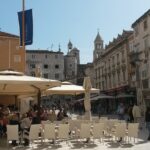

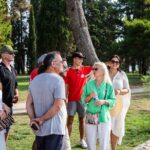

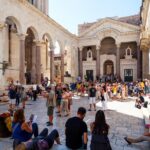

Golden Gate and Gregory of Nin: language in stone
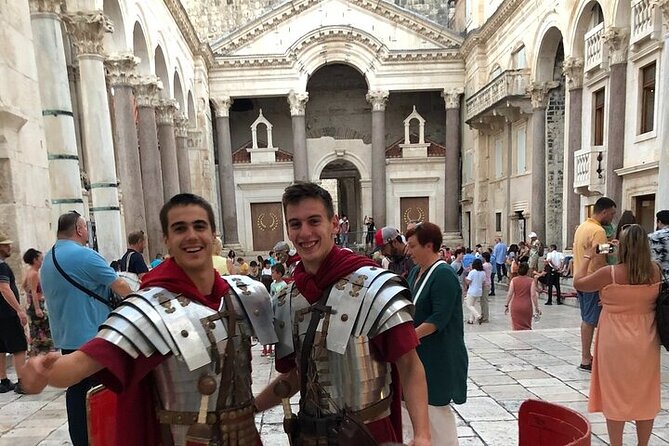
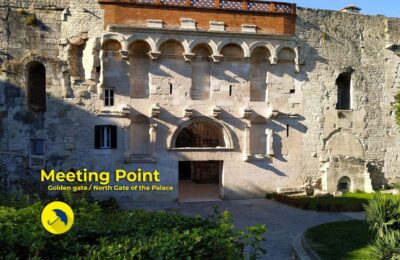
The Golden Gate is the main entrance of Diocletian’s Palace. This stop has that “turn point” feeling, because entrances always symbolize power and control. You’ll learn about the gate’s significance and see the statue of Gregory of Nin.
What I find smart here is that the guide ties the statue to something bigger than sightseeing. Gregory of Nin becomes a lesson in how history gets carried into language and identity. It’s the kind of detail that makes your later conversations in Split make more sense, like when people reference traditions and cultural roots.
You also get to look at the palace as a whole, from a doorway point of view. It’s not just “ruins.” It’s an entry system that once mattered to the way the palace moved people and messages.
Riva Harbor and the bronze model: visualizing what you can’t fully see
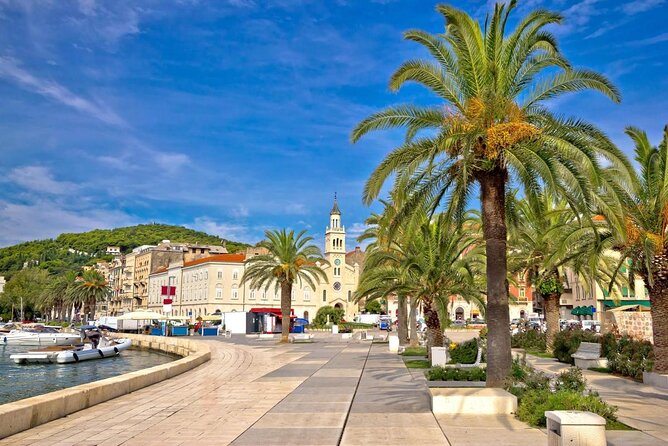
Then you head to Riva Harbor, where you can see a bronze model of Diocletian’s Palace. This is a genius move for anyone who struggles to picture scale from ground level.
Walking through ruins teaches shapes, but it doesn’t always teach the whole. The model helps you connect the dots between what you saw inside the palace walls and how the complex fit into Split as a city.
At Riva Harbor, the story also shifts a bit. You’ll learn about the history of the promenade itself. That matters because it shows how Split didn’t just inherit ancient walls. It kept building, adapting, and using the waterfront as a living center.
If you like photos, this is a great zone. Even if weather isn’t perfect, the harbor area tends to give you the “I’m here” sense you want after spending time in stone geometry.
Fruit’s Square and Marko Marulić: Venetian influence and Croatian literature
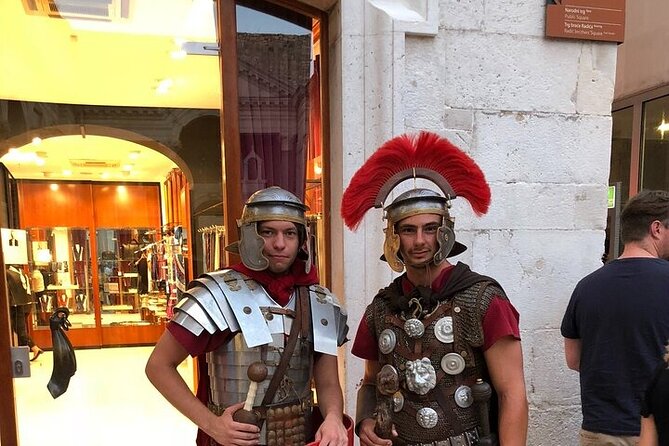
Next is Fruit’s Square (Trg Brace Radic). This stop feels like a classic old-town pivot point, where the tour steps out of purely Roman discussion and into the later story of Split.
You’ll learn about a Venetian citadel from about the 15th century. Even if you don’t know much Venetian history, the guide’s explanation helps you connect the architectural vibe to real political influence.
The other standout name here is Marko Marulić, described as the father of Croatian literature. That detail is more than trivia. It helps you understand why certain monuments and street-level landmarks feel culturally loaded. You start seeing Split as a place that values language, writing, and identity, not only monuments.
This stop is also a good moment to look around and absorb the square as a real public space. It keeps the tour from feeling like a checklist.
Split Synagogue pass-by: a quick chapter you should not skip
You’ll pass by the Split Synagogue, a 16th-century site. The tour includes the pass-by, with learning about the history of the Jewish people in Split.
One important practical point: admission to the synagogue is not included. That means you might simply see the exterior or the relevant viewpoint, not go inside during the tour itself.
Still, this stop is worth it for the context. Split has layers, and the Jewish story is one of the pieces you’d likely overlook if you only chase Roman landmarks. Even a short explanation here makes the city feel more complete.
If you care about visiting the synagogue interior, plan extra time for it on your own. The walk is designed to give you a respectful snapshot, not a full religious-history tour.
Pace, comfort, and getting the most from a small private group
This is a private tour/activity, meaning only your group participates. That matters because you can move at a more comfortable pace than you might on a standard group bus or crowded walking tour.
The route is mostly about short stops with walking between them, totaling around 1 hour 30 minutes. For most people, that’s a perfect length. It’s long enough to give you a coherent story, and short enough that you don’t feel trapped if the weather turns.
But you should be aware of one comfort consideration: it’s not recommended for travelers who have issues with high steps. The old center of Split can include uneven paving and stair segments, even on short routes.
If you’re unsure, think honestly about your mobility on cobblestones and steps. If that’s a problem area for you, choose a different kind of tour or confirm with the operator before you go.
Language note: the tour is listed as in Italian. If you speak Italian comfortably, you’ll get the full experience. If your Italian is basic, you may still follow the big storyline, especially at the Peristyle and Golden Gate stops where visual cues do a lot of work.
Who should book this tour in Split?
I’d book this if you want:
a clear introduction to Diocletian’s Palace
Italian storytelling with solid historical framing
- a compact walk that helps you navigate before you explore independently
It also works well if you’re traveling with someone who doesn’t want a long museum day. You get the key palace highlights, then you can spend the rest of your time wandering Riva, squares, and side streets.
If you love deep museum exploration or you want to spend an hour inside exhibits, this might feel a bit too short and focused. The substructures museum part is not visited during the tour, so you’d need extra time elsewhere to go further.
Should you book this Private History Split Walking Tour?
Yes, if your goal is a high-value orientation to Split’s most important layers in a small private setting. The guide-driven format saves you from the most common problem in Diocletian’s Palace, not knowing what you’re looking at while you’re looking at it.
Skip it only if you want a full-on museum visit as part of the same ticket, or if your mobility does not handle higher steps. Otherwise, this is one of the smartest ways to turn Split from “cool ruins” into a story you can repeat later when someone asks what Diocletian did to the city.
FAQ
How long is the Private History Split Walking Tour?
It lasts about 1 hour 30 minutes.
Is this tour private or part of a larger group?
It is a private tour/activity, so only your group will participate.
What language is the tour in?
The tour is listed as in Italian.
What is the price per person?
The price is $69.39 per person.
Where do we meet the guide?
Meet at Peristil ulica Peristil ul., 21000, Split, Croatia.
Are tickets included for all stops?
Admission tickets are free for the palace-related stops listed (including the Peristyle, Vestibulum, substructures, and Golden Gate), but the Split Synagogue admission is not included.
Does the tour include a mobile ticket?
Yes, a mobile ticket is included.
Is it refundable if my plans change?
Free cancellation is available up to 24 hours in advance for a full refund.
More Walking Tours in Split

More Tours in Split

More Tour Reviews in Split

Not for you? Here's more nearby things to do in Split we have reviewed






More Split City & Day Tours to consider.
 ★ 4.8Krka Waterfalls Trip with Boat Cruise and SwimmingFrom $3110,519 reviews
 ★ 5.0Krka Waterfalls, Food & Wine Tasting TourFrom $459,326 reviews
★ 4.9Krka Waterfalls, Food & Wine Tasting TourFrom $446,598 reviews
★ 5.0Krka Waterfalls, Food & Wine Tasting TourFrom $459,326 reviews
★ 4.9Krka Waterfalls, Food & Wine Tasting TourFrom $446,598 reviews
 ★ 4.6Split/Trogir: Blue Cave, Mamma Mia, Hvar and 5 Island TourFrom $1096,320 reviews
 ★ 4.5Blue Lagoon & 3 Islands Cruise with Lunch from SplitFrom $785,756 reviews
 ★ 4.9Old Town and Diocletian Palace Walking TourFrom $174,727 reviews
 ★ 4.9Blue Lagoon Boat Party with DJs, Shots & After PartyFrom $474,610 reviews
 ★ 5.0Krka Waterfalls Tour, Boat Cruise & SwimmingFrom $324,489 reviews
Explore its other useful categories