
REVIEW · SPLIT CITY & DAY TOURS
Split: Cultural Walking Tour with Anthropologist Guide
Split has a talent for turning history into debate. This walk is built for people who want the stories behind the stones, not just the stones. You get a cultural walking tour of Split’s center, guided by an anthropologist who connects contested past and present to the city you see today. I especially liked how the tour treats sensitive topics as part of local reality, not as awkward side notes.
My other big plus is the structure. You’ll hit the main landmarks, but each stop is used to explain big themes like politics, geopolitics, religion, identity, demographics, sexuality, history, and economics, with matching audio-visual material. The only real drawback to consider is that if you want a purely classical, comfortable sightseeing route with no controversy, this is not that kind of tour.
Key things to know before you go
- Anthropologist-led storytelling focused on contested history and current social issues
- Main sites plus context, so even first-timers can follow along
- Audio-visual material is included for each topic covered
- Designed for the intellectually curious, especially if you like complexity
- Covers “taboo” subjects in a direct, no-nonsense way
Split’s Controversy-Focused Walk: What Makes It Different
This tour is for your inner question-asker. Instead of repeating the usual “this is old, that is pretty” script, the guide turns each place into a prompt: Why do people argue about this? What gets remembered, what gets softened, and what gets fought over?
What makes it work is the balance. You still get a sensible core route through Split’s central highlights. But the conversation runs under the surface the whole time. You’re learning how Croatian society makes sense of itself, and why that has consequences for politics and daily life.
If you’re the type who loves architecture, you’ll still get plenty of that. But you’ll also get interpretation. The guide reads buildings and public spaces like cultural evidence. That’s a different feeling from a standard walking tour, and it’s the reason many people book this on day one, then keep the lens going for the rest of their trip.
You can also read our reviews of more walking tours in Split


Marin and the Anthropologist Approach in Plain English
The guide for this experience is Marin, a cultural anthropologist by training. In practice, that means you’re not just hearing facts, you’re seeing how people build identity through stories, symbols, and official memories.
Marin’s style, as reflected in the way the tour is described and the feedback you’ll find from others, is structured and interactive. He keeps connecting what you’re looking at to the bigger questions, like how different groups see history, or why certain topics stay sensitive in public talk.
One more thing I appreciate about this approach is how it handles complexity. The tour is built around the idea that the “easy version” of history is incomplete. You’re not pushed into jargon, either. It’s more about clear explanations you can carry around in your head as you walk.
Meeting at Park Josipa Jurja Strossmayera: Start Where Locals Start
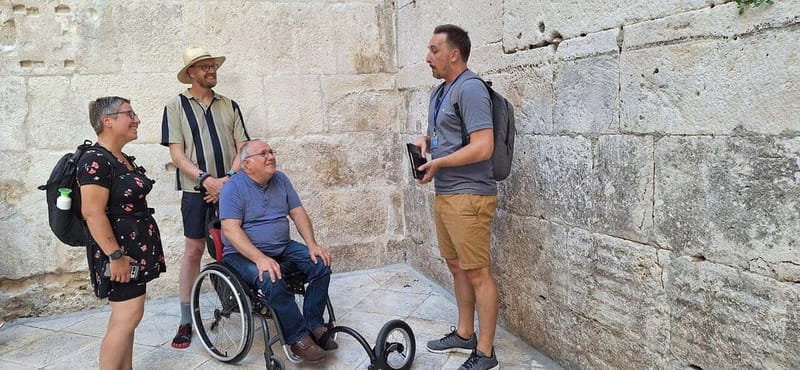
You meet at Ul. kralja Tomislava 12, in Split, at a big park. The meetup point is next to the fountain in the middle of the park.
That matters more than you might think. Starting in a park gives you a calm ramp-up before you enter the tighter, more crowded core. It also helps if you need a moment to get your bearings. The tour is wheelchair accessible, so the route and timing are planned with that in mind, even though it’s still a walking tour.
Plan to arrive a few minutes early. With this kind of discussion-heavy tour, you get more out of the first minutes, when the guide sets expectations and frames what you’re about to see.
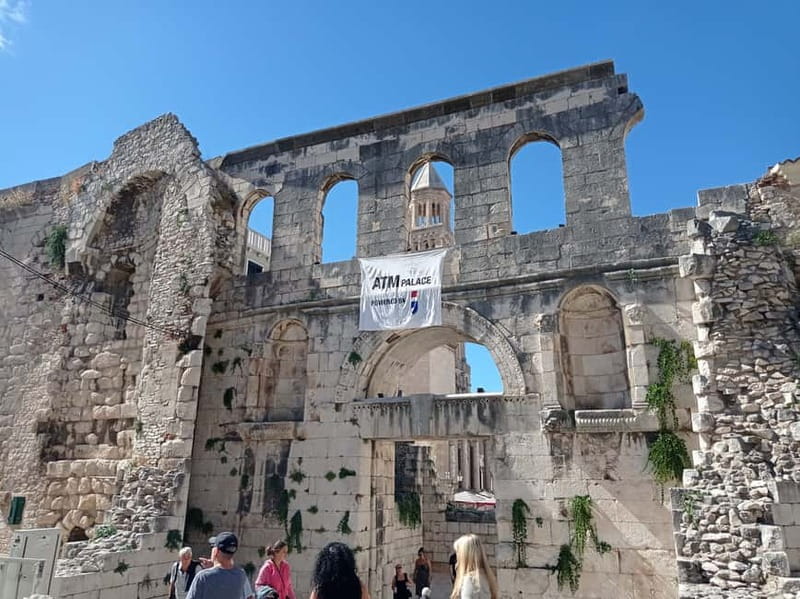
Golden Gate, Peristil, Diocletian’s Cellars: Power Gets Reinterpreted
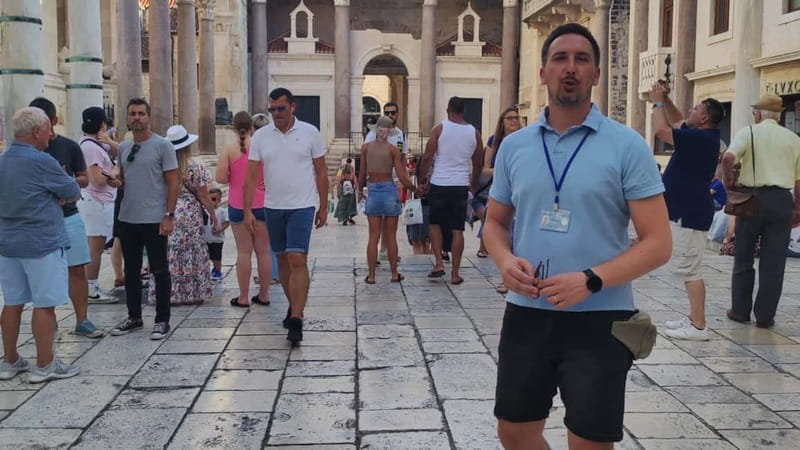
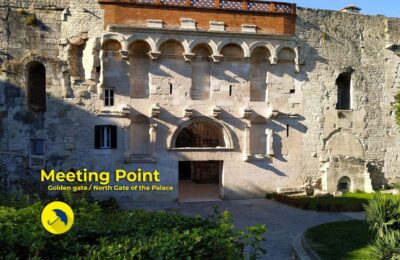
The route begins with a guided stop at Golden Gate for about 15 minutes. From there you move to Peristil for another 15 minutes, then to Diocletian’s Cellars for 10 minutes.
These are some of the most recognizable Central Split touchpoints, so you’ll likely feel comfortable quickly. But Marin doesn’t treat them as postcards. He uses them as anchors for a bigger lesson: how the city’s past keeps getting rewritten in the present.
In a tour like this, the architecture becomes a tool for talking about contested themes. You’ll hear how socio-political movements, religion, and identity form the way people talk about history. It’s not technical. It’s thematic, and it’s the reason this works for first-timers as well as people who already know the basics.
A practical note: because the stops are short, listen for the guide’s key comparisons and follow the thread from place to place. If you drift into “I know this already,” you’ll miss the point of the tour.
People’s Square to Židovski prolaz: Identity, Demographics, and Who Belongs

Next up is People’s Square for about 15 minutes, then Židovski prolaz for 10 minutes.
This is where the tour starts to feel extra intentional. People’s Square is a public space, so it’s ideal for talking about how groups negotiate belonging and how history affects politics. Židovski prolaz, literally tied to the Jewish name in the street/passage, becomes part of the same conversation about demographics and religion, and how communities are remembered or marked in public space.
What you should expect here is not a lecture. It’s a guided reading of place. Marin’s goal, according to the way the tour is described, is to connect taboos and contemporary controversies back to what you can still see in the city today.
If you like tours that explain why arguments exist, you’ll enjoy this section. If you prefer your travel stories to avoid sensitive topics, you may find it emotionally sharper than typical sightseeing.
You can also read our reviews of more guided tours in Split





Fruit Square, Riva, Republic Square: Everyday Space, Big Meaning

Then you’ll move through Fruit Square for around 15 minutes. After that there’s a quick pass along Riva for about 5 minutes, followed by Republic Square for about 15 minutes.
Here’s the cool trick this tour pulls. It treats the places you might casually stroll past as evidence of larger forces. Fruit Square and Republic Square are easy to recognize as everyday, social spaces. Yet the tour connects them to economics, identity, and politics, and shows how the past can shape what people feel is normal, fair, or contested.
The Riva pass is short, but it’s useful. It gives you a visual reset between deeper stops. You still get the continuity of the narrative, but you’re not stuck in one intense mode for the full two hours.
If you’re the kind of person who loves people-watching, this segment gives you permission to think about what you see. You can look at how public life operates and connect it back to the themes the guide introduced earlier.
Trumbićeva obala Finish: Take the Lens With You
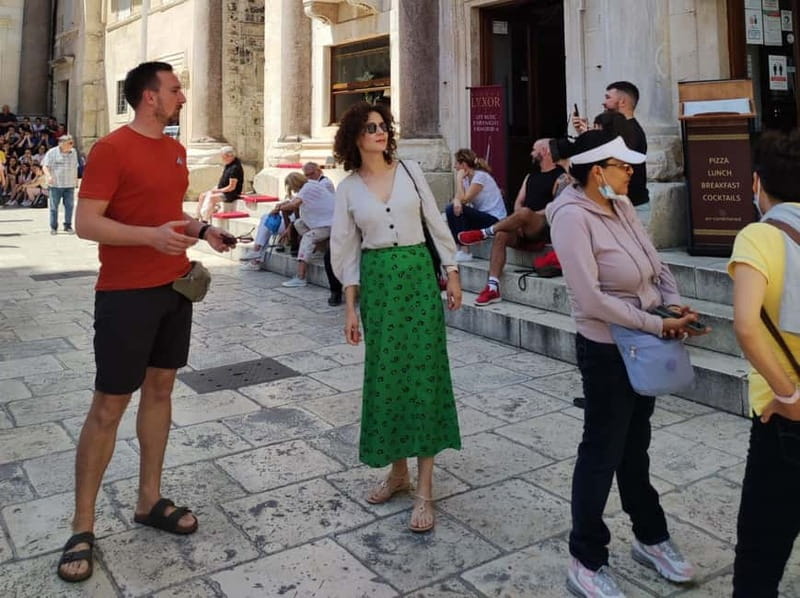
The tour finishes at Trumbićeva obala. The activity is also listed to end back at the meeting point, so treat this as “near the central area where you can easily reposition yourself.” In real life, these tours often mean you end in the old city zone and can get to your next stop without much hassle.
Either way, this final stretch is where you consolidate the experience. By the time you reach the end, you should have a clearer sense of why Split feels layered. The controversies you heard about are not just trivia. They’re the scaffolding behind how people talk, vote, remember, and define identity.
This is also a good moment to ask follow-ups. If something stuck with you, like a theme around religion, sexuality, economics, or geopolitics, the guide is likely to connect it back to what you saw.
One extra positive detail from feedback on this tour: the guide has handled weather and accessibility needs thoughtfully, including making time for interpretation so a deaf guest could enjoy the tour too. That’s a sign the tour isn’t just content-heavy, it’s considerate in delivery.
Price and Value: Why $33 Can Feel Like a Bargain
The price is $33 per person for 2 hours. On paper, that’s in the same universe as many walking tours. The difference is what you’re paying for.
You’re not just paying for directions and general history. You’re paying for:
- An anthropologist-led lens on controversial, contested issues
- A route that still includes Split’s main sites
- Included audio-visual material for each topic
If you’ve spent time on typical tours that skim the surface, you know how fast you forget the details. This one is designed to stick because it gives you context you can reuse. Once you understand how past narratives shape present debates, you start noticing those patterns on your own, in museums, in conversations, and even in how locals refer to the city.
Also, it’s explicitly described as having no extra costs. That means you can focus on the experience without worrying about add-on fees for stops or materials.
Who Should Book This Tour (and Who Might Skip It)
This is a great match if:
- You’re intellectually curious and like learning how societies argue with themselves
- You want insight that connects architecture and public spaces to politics and culture
- You like tours that cover real issues, including sensitive subjects
You might skip it if:
- You want a straightforward checklist of sights with neutral commentary
- You prefer to avoid controversial topics while on holiday
The good news is that the tour is built to include main center sites, so you won’t feel lost even if you’re new to Split. It’s not only for people who already know the city.
Should You Book This Tour?
If you like your travel with context, I’d book it. The combination of a cultural anthropologist guide, included audio-visual support, and a route through recognizable Split landmarks makes this a strong value at $33. It’s also one of the better choices for day one because it gives you a framework for the whole trip.
If you’re hoping for a mellow, purely sightseeing walk, this may feel too pointed. But if you want Split to make more sense, including the parts people argue about, this is exactly the kind of tour that leaves you thinking.
FAQ
Where does the tour meet?
You meet at Ul. kralja Tomislava 12, 21000 Split, Croatia. It is a big park, and you meet next to the fountain located in the middle of the park.
How long is the tour?
The tour lasts about 2 hours.
What language is the tour in?
The tour is guided in English.
Is the tour wheelchair accessible?
Yes, the tour is listed as wheelchair accessible.
How much does it cost?
The price is $33 per person.
What’s included in the price?
The tour includes additional audio-visual material for each topic covered.
Are there any extra costs?
No extra costs are listed.
Is free cancellation available?
Yes. You can cancel up to 24 hours in advance for a full refund.
Can I reserve now and pay later?
Yes. The tour offers reserve now, pay later.
More Walking Tours in Split

More Tours in Split

More Tour Reviews in Split

Not for you? Here's more nearby things to do in Split we have reviewed






More Split City & Day Tours to consider.
 ★ 4.8Krka Waterfalls Trip with Boat Cruise and SwimmingFrom $3110,519 reviews
 ★ 5.0Krka Waterfalls, Food & Wine Tasting TourFrom $459,326 reviews
★ 4.9Krka Waterfalls, Food & Wine Tasting TourFrom $446,598 reviews
★ 5.0Krka Waterfalls, Food & Wine Tasting TourFrom $459,326 reviews
★ 4.9Krka Waterfalls, Food & Wine Tasting TourFrom $446,598 reviews
 ★ 4.6Split/Trogir: Blue Cave, Mamma Mia, Hvar and 5 Island TourFrom $1096,320 reviews
 ★ 4.5Blue Lagoon & 3 Islands Cruise with Lunch from SplitFrom $785,756 reviews
 ★ 4.9Old Town and Diocletian Palace Walking TourFrom $174,727 reviews
 ★ 4.9Blue Lagoon Boat Party with DJs, Shots & After PartyFrom $474,610 reviews
 ★ 5.0Krka Waterfalls Tour, Boat Cruise & SwimmingFrom $324,489 reviews
Explore its other useful categories