
REVIEW · WALKING TOURS
Private History and Trivia Walking Tour by a Local Guide
Split tells its story in stone and shade. This private 1 hour 45 minute walking tour is a smart way to get your bearings in Old Town while learning what Diocletian’s Palace became over centuries, with a local guide leading a tight route you can walk but big buses usually skip. You’ll move through major sights and quieter corners, all with a mobile ticket and a small group capped at 15.
I love how practical this is for time-tight days. You get big landmarks like the Peristyle and the Cathedral of Saint Domnius, plus side stops that explain the palace’s layout and how Christianity shaped spaces like the old Temple of Jupiter. I also love that the guide, like Ivan, answers questions with real detail and even a playful sense of humor, which makes the history easier to hold in your head.
One drawback to plan for: it is a compact walk. If you want to linger for long photos at every stop, or you prefer a slower pace with fewer transitions, this may feel a bit fast.
Key things I’d focus on before you go
- Private guide, small group (max 15), so you can ask questions without feeling rushed
- Diocletian’s Palace on foot, including substructures you cannot really see from the street
- Christian-era transformations, like the Temple of Jupiter becoming a baptistery
- A route that stitches squares and gates together, not just one famous courtyard
- Ivan’s storytelling style, known for being friendly, fun, and in-depth
- Stops marked admission free, so your sightseeing budget stays predictable
A fast, private history fix in Split’s Diocletian heart
Split is one of those cities where the main sites are close together, but they still feel confusing at first. This tour helps you connect the dots fast. In about 1 hour 45 minutes, you get a guided walk that moves in a logical loop through Diocletian’s Palace and the surrounding Old Town streets.
The big value here is not just seeing famous buildings. It’s learning why they’re where they are, and what changed as power and religion shifted. You’ll also get what I call city operating instructions: where the palace walls matter, how the squares relate, and how to read the street plan when you’re wandering afterward.
This is also a good choice if you dislike wasting time. The route is built for walking, including tight passages that buses simply do not reach.
You can also read our reviews of more walking tours in Split


Meeting at Riva Harbor and lining up the palace story
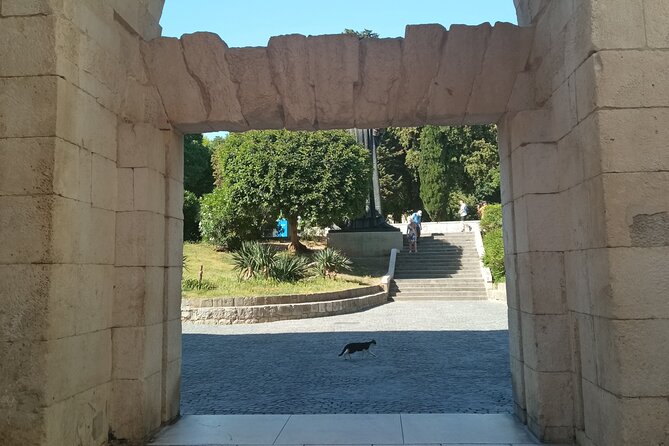
You start at Obala Hrvatskog narodnog preporoda 22, on the promenade at Riva Harbor. This first stretch matters more than it sounds. From the waterline, your guide points out the southern wall of Diocletian’s Palace and frames the harbor view, so the rest of the day stops feeling random.
You also get a sense of the coastline and the eastern and western promenades. That early orientation pays off when you later climb and turn through gates and squares. Even if you only remember one thing from the first minutes, it should be this: Diocletian’s Palace is not an isolated ruin. It’s the skeleton around which Split grew.
Practical tip: wear shoes you trust. You’ll be on stone streets and uneven Old Town ground.
Through the Bronze Gate, down into Diocletian’s substructures
One of the most memorable parts is entering the Diocletian Palace substructures through the southern entrance, the Bronze Gate. This is where you start seeing history in layers. These underground or semi-covered spaces help you picture how the palace worked when it was in active use, not just when it became a scenic backdrop.
Your guide explains the role these substructures played through history, and you’ll walk in a way that makes the layout easier to visualize later when you are looking at arches, doors, and walls from above. It’s the kind of stop that feels different from standing on the main street outside a monument.
Value check: because this is a guided visit, you’re not just looking at stone. You’re getting the “why” behind it, in plain language.
Peristyle Square, St Domnius, and the Jupiter to baptistery twist
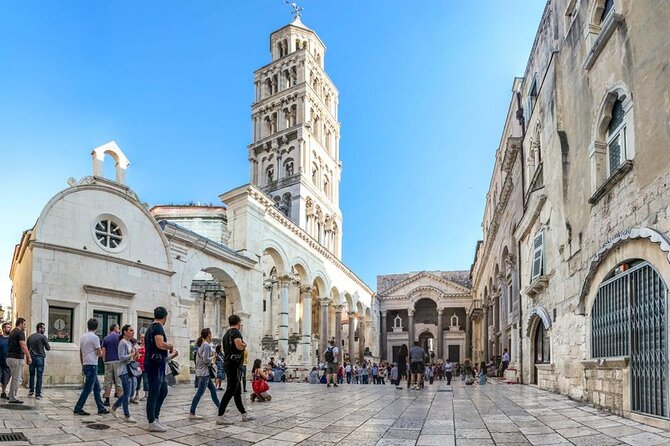
After the substructures, you reach the heart of the palace complex: the Peristyle Square. This is the central ancient square that anchors the whole story. You’ll get the historical and cultural context for what you’re seeing, which helps you understand why so many later buildings were built around these Roman lines.
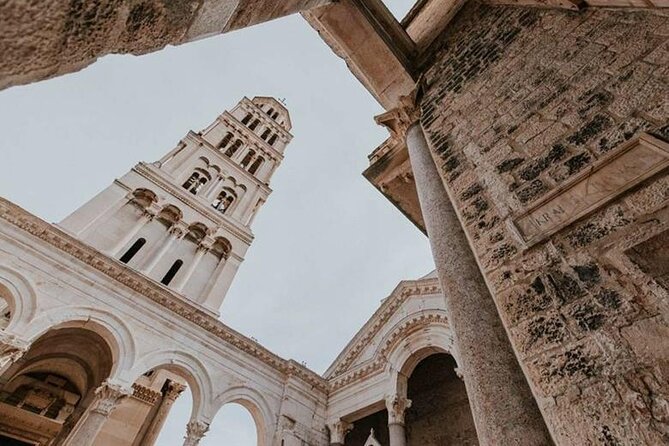
From there, the walk turns religious and architectural. At the Cathedral of Saint Domnius, you learn about Diocletian’s mausoleum and how it was transformed into a cathedral. Your guide also points out construction style details for the cathedral and the adjacent bell tower, so you can see the changes rather than just hear a name.
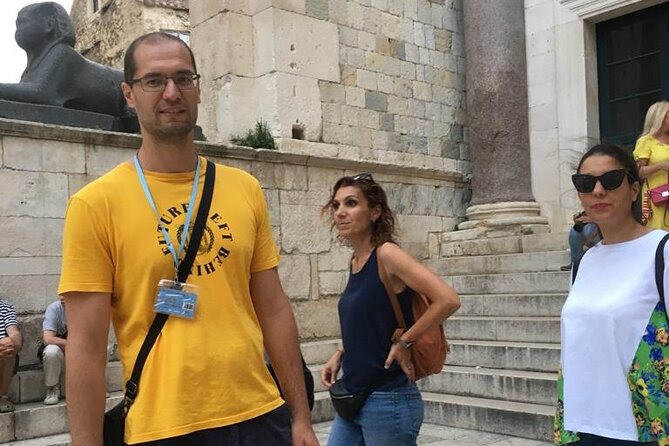
Then comes a clever pivot. You visit the Temple of Jupiter, and you learn how it was turned into a baptistery as Christianity spread within the palace walls. The Sphinx in front is part of the atmosphere, and you’re guided through what that setting is signaling historically.
If you like history that actually connects buildings to ideas, this section is a strong one. It turns archaeology into a timeline you can picture while you walk.
Fruit’s Square and Narodni trg: squares, statues, and street drama
Split’s best stories often happen between the big landmarks. This tour leans into that.
You pass through the narrowest streets in Split, including the famous passage called Pusti me Proc. Then you reach Fruit’s Square (Trg Brace Radic), where the guide talks about the town’s development, including what life was like when Split was not the major center it later became.
This stop also gives you visual anchors beyond architecture: you pass the statue of Marko Marulić, and you see the palace of the Milesi Family from the 17th century. Moments like this help you remember Split as a lived-in city, not just a monument.
Next you move to Narodni trg, the main square in Split. Here your guide explains how it developed into the town’s main square and how the town expanded over time. Along the way, you’ll pass a recently renovated palace that was once property of a noble family, the old City Hall, and palaces associated with noble families, including a palace belonging to one from Korčula.
Why I like this portion: squares in historic cities can feel generic, but the guide makes them meaningful. By the time you’re done, you’re not just seeing a pretty plaza, you’re seeing civic power move across the map.
You can also read our reviews of more guided tours in Split





Zeljezna Vrata and the gate-and-palace pattern
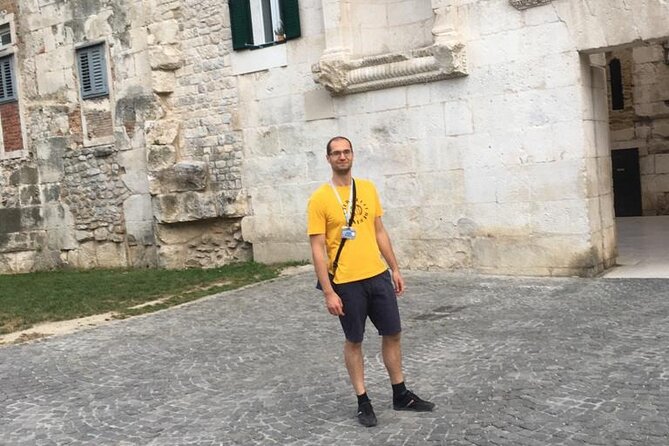
From Narodni trg, you head toward the eastern side of the palace area and reach Zeljezna Vrata, the iron gate. This stop is short, but it’s the kind of short that sticks because the iron gate has a history of its own, with multiple uses over time. You’ll also notice how it fits into the palace wall structure, which makes it easier to understand later when you look at the gate from different angles.
As you move, you pass more palaces from different eras, including a 17th-century palace built by the wealthy Cindro family, and an Italian family palace called Augubio from the 15th century. This is a useful pattern for visitors to learn: even when Roman foundations remain, later wealth and style start layering over the top.
If you care about architecture, take a moment here to look at details like doorways and window rhythm. The tour helps you notice them without turning it into a technical lecture.
Papalic Palace and the City Museum of Split
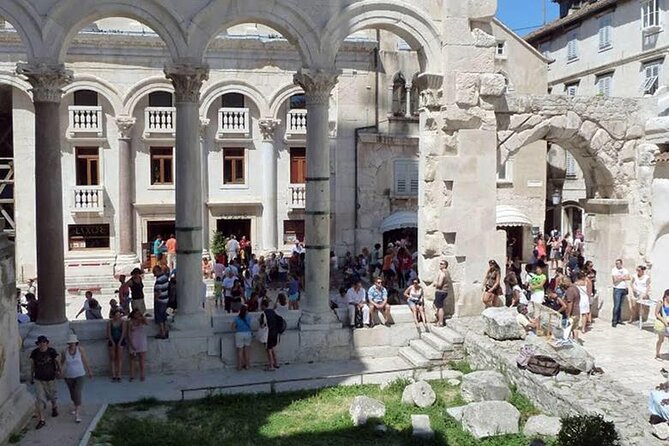
The City Museum of Split is located in the Papalic Palace. Even though the time here is brief, you get a quick sense of why the building matters historically. There is also a fun pop-culture connection for Game of Thrones fans: there is an interesting, albeit bloody scene tied to the location in front of the palace.
A quick note on pacing: if you’re a museum person, you might wish you had more time to go deeper. But for a 1 hour 45 minute city starter, the museum stop works as a marker. It gives you something to follow up on later if you want to.
Golden Gate, Grgur Ninski by Ivan Meštrović, and St Arnir’s bell tower
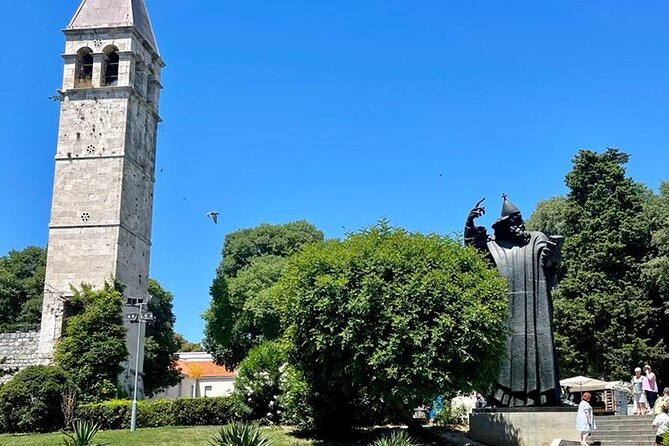
You continue to the Golden Gate, the northern entrance to Diocletian’s Palace. Your guide highlights it as especially beautiful and decorated, and explains what the construction reveals about Roman building expertise.
Right across from the northern gate, you’ll see the Grgur Ninski statue by the famous Croatian sculptor Ivan Meštrović. This is another memory anchor. The guide explains why Bishop Grgur of Nin represents such an important idea in Croatian culture, so the statue feels less like a landmark sign and more like a cultural statement.
Then you move to the bell tower of St Arnir. Beside the statue, the tour points out the bell tower and the chapel of Saint Arnir, plus remnants of an early Christian church. This is the kind of stop that helps you spot how Christianity gradually shaped the palace spaces in different ways.
If you’re trying to understand Split as a cultural crossroads, this section does that job. It shows a city where Roman and later eras are physically mixed together.
Marmontova Ulica views and the walk’s best payoff
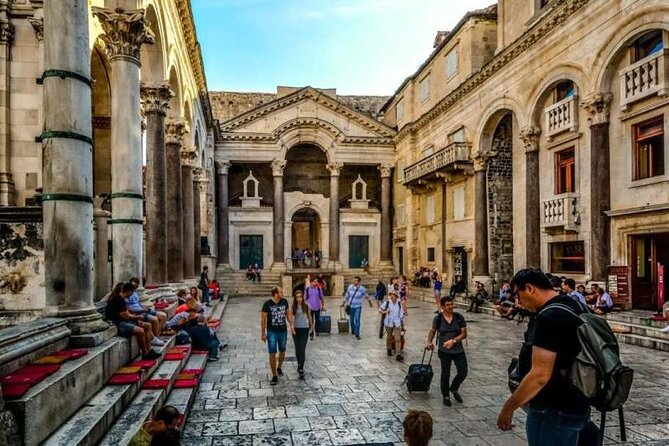
You finish on Marmontova Ulica, at the top of the street with views that open toward the Croatian National Theater and the Monastery and Church of Our Lady of Health. Ending here is smart. After learning about gates, squares, and palace substructures, you get a broader perspective of where everything sits in the city.
Your guide also covers the historical aspect of a short-lived but important chapter tied to the area. Even without taking notes, you should feel like you understand how Split’s skyline connects back to the Old Town core.
Then the tour ends back at the meeting point, so you’re not left stranded across town.
Price and timing: does $53.95 feel worth it?
At $53.95 per person for about 1 hour 45 minutes, the price is reasonable when you compare what you get: a private group experience, a small cap of up to 15 people, and a guided route that takes you through major palace spaces on foot. Many of the key stops are marked as admission ticket free, so you are paying mostly for interpretation and access, not entry fees.
It is also a good value if you want a history guide who can answer your questions. In the feedback you see a consistent theme: Ivan is friendly, funny, and willing to go deeper when you ask. I find that matters more than people realize. A great tour is not just a script, it’s the conversation you get when something sparks your curiosity.
Timing-wise, the tour runs Monday through Friday from 8:00 AM to 1:30 PM, within a long seasonal window. That morning slot is helpful in general for comfortable walking and for better light at stone buildings. If you’re planning summer travel, you’ll also want to reserve early. This one is booked about 91 days in advance on average, which suggests demand stays steady.
Who should book this tour, and who should skip it
This is a strong fit for you if:
- You have limited time and want a solid “what am I looking at” foundation in Old Town
- You like Roman history that connects directly to later Christian-era changes
- You want a guide who answers questions and keeps the tone friendly and humorous
- You enjoy walking routes that include narrow passages and palace interiors
You might want to choose something else if:
- You prefer relaxed pacing with long photo stops and minimal movement
- You are already deeply fluent in Diocletian’s Palace and want a more specialized focus
- You expect lots of museum time, since this tour keeps entries short and uses guidance to set context
Should you book this Split private history and trivia walking tour?
Yes, if you want a compact, high-impact introduction to Split that feels like it was planned by someone who actually knows the city. The best reason to book is the combination of Diocletian’s Palace access on foot plus a guide who can turn landmarks into a story you remember.
If you’re visiting for the first time, or you want your second day to make sense, this tour is a great investment. I’d book it early in your stay so the rest of your wandering becomes easier.
FAQ
How long is the private History and Trivia Walking Tour in Split?
The tour lasts about 1 hour 45 minutes.
Where do we meet, and does the tour end there too?
You start at Obala Hrvatskog narodnog preporoda 22, 21000, Split, Croatia. The tour ends back at the meeting point.
Is this tour truly private, and what is the group size?
It is a private tour/activity. Only your group participates, with a maximum of 15 persons.
Which languages are the guides available in?
The tour includes local licensed guides who speak English, French, German, Spanish, and Italian.
Do I need paid admission tickets for the stops?
The itinerary lists each stop as Admission Ticket Free, so you should not expect extra admission fees for these specific points.
What is the cancellation policy?
You can cancel for a full refund up to 24 hours in advance. If you cancel less than 24 hours before the experience starts, the amount paid is not refunded.
More Walking Tours in Split


More Tours in Split

More Tour Reviews in Split

Not for you? Here's more nearby things to do in Split we have reviewed







More Walking Tours to consider.
 ★ 4.9Old Town and Diocletian Palace Walking TourFrom $174,727 reviews
 ★ 5.0Walking Tour of Split and Diocletian’s PalaceFrom $482,588 reviews
 ★ 5.0Krka Waterfalls tour with Trogir Walking tour and Krka panoramic boat cruiseFrom $481,659 reviews
 ★ 5.0Split & Diocletian’s Palace Walking TourFrom $211,125 reviews
 ★ 5.0Walking Tour of Split with a ‘Magister’ of HistoryFrom $341,122 reviews
 ★ 5.0Split Walking Tour with Professor of HistoryFrom $24926 reviews
 ★ 4.7Diocletian Palace & Old Town Guided Walking TourFrom $17882 reviews
 ★ 4.7Krka Waterfalls Cruise & Trogir Walking TourFrom $47681 reviews
Explore its other useful categories