
REVIEW · SPLIT CITY & DAY TOURS
Experience Split With Local Professional Historian – Small Group
Diocletian’s Palace feels bigger after you hear it. I love the small group size (up to 12), and I love that you get a licensed history guide plus a display book with pictures and 3D reconstructions that makes the ruins easier to read. Instead of just pointing at stones, the guide links each stop to how people lived and believed in different eras.
One thing to plan for: this is a smart two-hour overview with a lot of key sights covered, but many parts are viewed from outside, so you may still want extra time later if you want long interior visits. Also, the tour depends on good weather, so wear comfortable shoes and be ready for a bit of walking.
Key points to know before you go
- Up to 12 people keeps the pace friendly and the Q&A real.
- Historian-led route with a master’s in history focuses on meaning, not memorization.
- 3D reconstructions and photo book help you visualize what you are standing in front of.
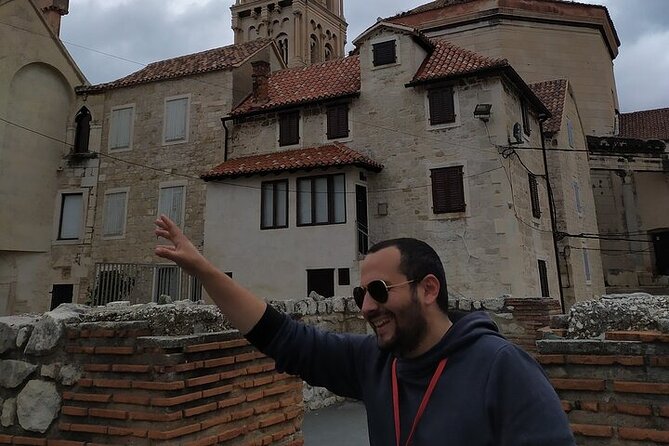
- Photo help from Boris means you can actually get good shots at the iconic angles.
- Main landmarks plus local daily-life spots like Riva and Pjaca square, not just a palace circuit.
- Free to stand and look at stops, but no admission tickets are included if you want to enter interiors later.
Why this Split walking tour works
If Split is your first stop in Croatia, this tour gives you bearings fast. Diocletian’s Palace can look like walls and corridors at first glance. With a good guide, it turns into a map of power, religion, and everyday routines.
What makes this one click is the way the guide uses visuals. You do not just hear dates. You see pictures and 3D images that help you picture the palace as it once functioned. And because the group is small, the conversation stays practical, not rushed.
The other plus is local context. Boris, a longtime Split resident and history teacher by background, connects the Roman structures to what changed later, including Christianity’s arrival and the medieval city that grew around the palace. You also get personal stories, not just textbook facts, which is why the walk feels like a conversation with someone who actually cares.
You can also read our reviews of more tours and experiences in Split.

Meeting at Golden Gate, the palace’s front door
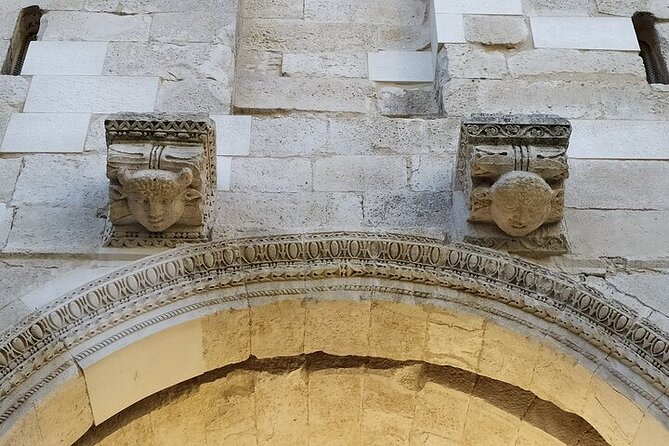
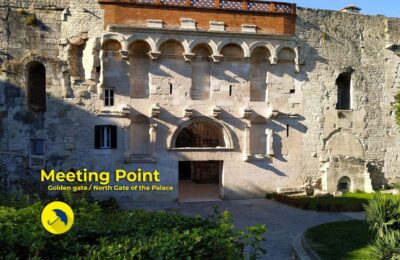
You start at Golden Gate, the northern entrance to Diocletian’s Palace. It is not literally made of gold, but it is a perfect start point because it is dramatic and obvious. The guide frames it as the palace’s public face, right across from another major landmark, the statue of Grgur Ninski.
At this first stop, the tour does something I really value: it sets the palace’s role before you get lost inside it. You learn why the entrance mattered and how this whole complex functioned as the emperor’s world inside a city.
This is also a good moment for photos. The guide can help you find angles that include both the gate and the bigger landmarks around it, which saves you time later when you are hunting for the best picture.
Grgur Ninski statue: a shortcut to personality and politics
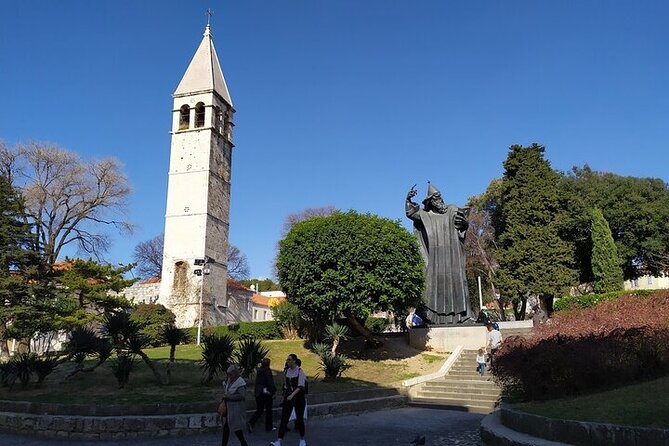
Next comes the Grgur Ninski (Gregory of Nin) statue, one of the most recognizable monuments in Split. The guide shares the story behind Gregory of Nin and why his name is tied so tightly to local identity.
The stop is short, but it works. It gives you a human anchor before the tour shifts fully into palace architecture and Roman authority. It also sets you up for later when you see how religion and political power overlapped in the centuries that followed.
Diocletian’s Palace: seeing the big pieces in order
The center of the tour is the Diocletian’s Palace area, starting from the Golden Gate side. The pace is built for first-timers. You cover the major zones without trying to do everything at once.
Here’s the trick: you get the palace explained in a logical flow. Instead of random monuments, you move through key functions.
- You hear about the Roman emperor Diocletian and what made this residence so important.
- You explore the Peristyle area, which helps you understand how people moved and how access worked.
- You get shown the Diocletian’s cellars area (described as the central substructure), and how that mattered historically and still matters for Split’s story today.
- You learn about the Triclinium, the emperor’s dining space, including how eating habits and dining organization reflected status.
Because many parts are viewed from specific positions, the 3D images really help. You stand in one spot, then the guide points out what you cannot see clearly from that angle. That is where the reconstructions earn their keep.
Quick note on admissions
No admission tickets are included, so you should treat stops as a walk-and-look experience. If you want to go inside specific interiors after the tour, you can, but you will need to plan that separately.


Peristyle: the palace center where people connected and separated
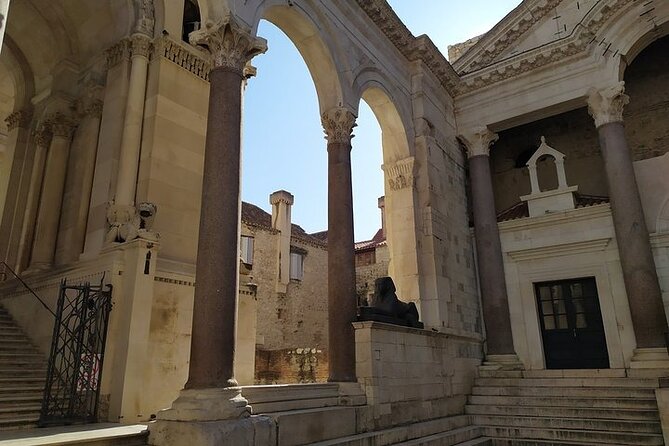
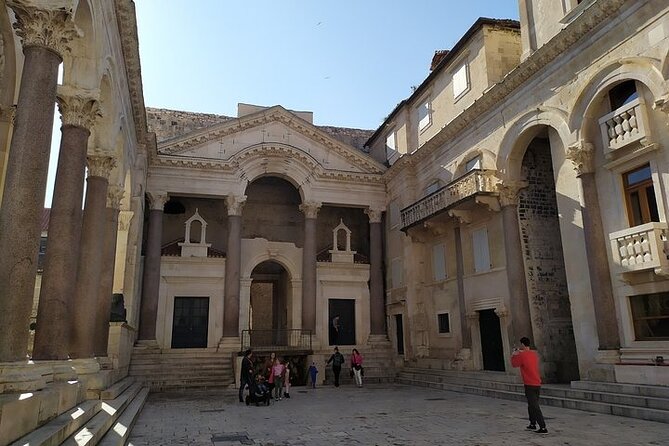
One of the most important stops is the Peristyle. This is the palace’s central space, and it is not just decorative. The guide explains the Peristyle’s role as a connector, and also a divider, between common people and the emperor.
Standing there, you start to understand the palace’s rhythm. You can look around and see how the space shaped movement. And the guide adds another layer by describing how later expansions and the rise of Christianity changed what people believed and how buildings were used.
This is one of those stops where a guide makes a big difference. Without context, it can feel like a pretty courtyard. With context, it becomes the social engine of the palace.
Cellars and the Triclinium: power, storage, and status
From the Peristyle area, you transition toward the cellars zone. Even without going deep, the guide explains how these spaces were used during different historical periods and why they matter for Split today. Think of it as the practical underlayer of a palace that was meant to last.
Then you check up on the Triclinium. This is the dining setup. The guide talks about Roman eating habits and how the emperor’s dining room was organized, which is a surprisingly effective way to make the palace feel real. Food and routine are universal. Once you understand how meals worked, even ancient furniture-less spaces begin to make sense.
Temple of Jupiter and St. Domnius: religion through the centuries
Roman religion was a major part of daily life, and the tour connects that directly to architecture. You visit the Temple of Jupiter from outside, and the guide explains why temples were essential in Roman residences.
Then you move to the Cathedral of Saint Domnius, also mainly from the outside during this experience. The guide points out significant parts and shares the story behind what you are seeing. Even if you plan to enter later, this stop gives you a sense of what to look for so you do not just stand there with your phone camera.
A nice touch here is how the guide warns you about notable interior details to watch for later. It turns your future self-guided visit into something focused, not random.
Vestibulum: the quiet pre-entrance to private space
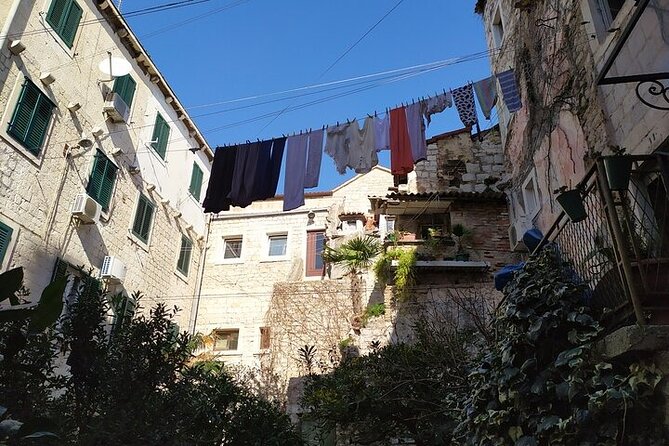
The Vestibulum is a short but meaningful stop. It is described as the pre-entrance to Diocletian’s private chambers, with decoration matching its importance. The guide explains what it looked like and what it was for.
This is where you start seeing the palace not as a single landmark, but as a set of spaces with different social roles. Public areas, semi-public areas, and private zones. The tour helps you feel that hierarchy.
Riva Harbor: where the city breathes now
After the Roman circuit, you shift gears to daily life at Riva Harbor, Split’s main promenade. The guide explains how Riva was built over the centuries and why it became central for locals.
This section is only a short walk in the schedule, but it is smart. It stops the tour from feeling like you are trapped in the past. You get a current-day sense of how people use the waterfront and where the city’s energy concentrates.
If you want a quick pause after more structured palace stops, this is a good spot to breathe, grab water, and let the information settle.
Fruit’s Square (Trg Brace Radic): a small name with a story
Next is Fruit’s Square, a charming little stop called Trg Brace Radic. The guide tells you why it is associated with fruit and points out an important monument in the middle, plus the surrounding sights that shape the square’s character.
This is the kind of stop that makes a walking tour feel local. You get a reason behind the name, and you learn to read squares as spaces where trade, gatherings, and civic identity played out.
Pjaca (People’s Square): your finish point with momentum
The tour ends on Pjaca, also known as People’s Square. This is the center of city happenings from medieval times into today. The guide shares the square’s story and highlights surrounding buildings such as the old City Hall area.
Right before finishing, you get suggested places to see next, meaning you leave with a mini action plan. I like that the tour doesn’t pretend two hours can do everything. It helps you pick a smart next step so you do not waste your limited time wandering.
Also, the guide’s teaching style is interactive. In several walks, Boris uses quiz-style questions that keep kids, teens, and adults engaged. One family even mentioned their daughter answering trivia during the tour. That kind of active learning makes the palace details stick.
Price and what you really get for $38.62
At $38.62 per person for about two hours, you are paying for more than a route. You are buying context, structure, and visuals.
Here’s how I think about value for this price:
- The tour covers a concentrated list of big-ticket sights in Split’s core area, including the Golden Gate, the palace zone, Jupiter Temple views, St. Domnius, Riva, Fruit’s Square, and Pjaca.
- You also get a trained local historian, not a casual storyteller.
- The display book with 3D reconstructions is part of the experience, and it solves a common problem in Diocletian’s Palace, which is visual confusion.
If you are the type who likes asking questions, this is the kind of tour where paying a bit more can actually save money later. You will avoid buying tickets for the wrong thing first, because you’ll understand what matters and what you can safely see from the outside.
One practical note: this experience is often booked ahead, with an average booking window of about 62 days. If you are traveling in peak season or on a popular date, book earlier rather than gambling.
Who this tour suits best
This tour is ideal if you:
- Want a first-time Split overview that connects Roman ruins to modern city life.
- Love history but still want it explained in plain language with visuals.
- Care about photography and would like help getting the right angles.
- Travel with kids or teens who do better with interactive teaching. The quiz-style approach is built for mixed-age groups.
It also works well for adults who want something more than a casual walk. Boris has a teacher’s rhythm, and the pacing keeps the tour from turning into a lecture.
A few drawbacks to consider
- Two hours is two hours. The route is carefully planned, so it cannot include long, slow wandering inside every building.
- Outside viewing is the norm. Several major stops, like Jupiter Temple and St. Domnius Cathedral, are described as outside visits during the experience.
- No admission tickets included. If you want interior time afterward, plan for that extra step and cost.
- Good weather matters. The tour requires decent conditions. If it rains or the weather turns, the experience may shift or cancel.
Should you book it?
Yes, if you want Diocletian’s Palace to make sense fast and you like learning from a real local historian. I especially recommend it for your first day in Split, when you need orientation before you explore on your own.
Book it even sooner if you care about seeing the palace without getting lost, because the 3D reconstruction book and the structured stop order do real work. You will also come away with practical suggestions for what to do next around Pjaca.
Skip it only if you already know the palace inside out and want pure museum time. This is an overview tour, not a long ticket-based interior marathon. For most visitors, though, it is one of the best ways to turn famous stone into a readable story.
FAQ
What language is the tour offered in?
The experience is offered in English.
How many people are in the group?
The tour has a maximum group size of 12 travelers.
How long does the Split walking tour take?
It lasts about 2 hours.
Where do we meet, and where does the tour end?
You meet at Golden Gate at Dioklecijanova 7, 21000, Split, Croatia, and the tour ends at People’s Square (Pjaca), 21000, Grad, Split, Croatia.
What’s included in the experience?
You get a local professional licensed guide with a master’s degree in history, plus a display book with 3D reconstruction images and pictures.
Are admission tickets included?
No. Admission tickets are not included in the tour price.
What is the cancellation policy?
You can cancel for a full refund up to 24 hours before the experience starts. The experience also requires good weather, and if it is canceled due to poor weather, you will be offered a different date or a full refund.
Are service animals allowed?
Yes, service animals are allowed.
Is there a mobile ticket?
Yes, the experience includes a mobile ticket.
More Tour Reviews in Split
Not for you? Here's more nearby things to do in Split we have reviewed





More Split City & Day Tours to consider.
 ★ 4.8Krka Waterfalls Trip with Boat Cruise and SwimmingFrom $3110,519 reviews
 ★ 5.0Krka Waterfalls, Food & Wine Tasting TourFrom $459,326 reviews
★ 4.9Krka Waterfalls, Food & Wine Tasting TourFrom $446,598 reviews
★ 5.0Krka Waterfalls, Food & Wine Tasting TourFrom $459,326 reviews
★ 4.9Krka Waterfalls, Food & Wine Tasting TourFrom $446,598 reviews
 ★ 4.6Split/Trogir: Blue Cave, Mamma Mia, Hvar and 5 Island TourFrom $1096,320 reviews
 ★ 4.5Blue Lagoon & 3 Islands Cruise with Lunch from SplitFrom $785,756 reviews
 ★ 4.9Old Town and Diocletian Palace Walking TourFrom $174,727 reviews
 ★ 4.9Blue Lagoon Boat Party with DJs, Shots & After PartyFrom $474,610 reviews
 ★ 5.0Krka Waterfalls Tour, Boat Cruise & SwimmingFrom $324,489 reviews